A Christian Perspective on AI Sentience
I’m a Christian and a fan of effective altruism. A key tenet of effective altruism is expanding the moral circle of concern. That is why effective altruists care for the distant poor, farmed animals, and people in the far future. Some effective altruists have considered the possibility of artificial intelligence (AI) sentience as a potential cause area. Now that everyone is talking about AI, the idea could gain traction. I think most Christians would immediately reject this, but I want to examine the arguments and offer a Christian perspective, even if mainstream concern over AI sentience never materializes. Part 1 will go over some philosophy of mind and Christian anthropology, while Part 2 will go over AI fundamentals and use the frameworks from Part 1 to evaluate whether AI sentience is possible or morally relevant. My thesis is that AI sentience, while theoretically possible under naturalism, is not compatible with a Christian worldview.
Disclaimer: Basically every single heading and hyperlink of this essay has dozens of books or academic papers devoted to it.1Link to sources and further reading. I am just trying to scrape together and introduce some basic concepts and insights from computer science, philosophy, and theology (none of which I’m an expert in) on a potentially important topic. This project was also helpful for me in understanding some of these topics a little better.
Part 1: Human
What is sentience?
Sentience is “the capacity to have positive and negative experiences, usually thought of as happiness and suffering.”2Anthis, J. R. (2018). What is sentience? Sentience Institute. The ability to suffer makes a being the subject of moral concern. We know humans and animals are sentient. We can imagine a hypothetical non-human, non-animal being could be sentient if it felt pleasure and pain, even if it was unlike us in every other way. Sentience requires consciousness, and might also be related to some other properties. To help think about sentience and its criteria, I’m also going to use a set of relevant biblical and scientific attributes that are assigned to different elements of creation. These attributes, which I’ll define as we go, are: corporeality, biology, agency, consciousness, the breath of life, the soul, the spirit, the image of God, and the rational mind.
What is consciousness, really?
If sentience requires consciousness, we’ll first need to understand consciousness and its nature. The problem is, no one understands consciousness. The philosophy of mind is very confusing, and this is just an amateur overview of some of it. These paragraphs are meant to highlight how a naturalist worldview might try to make sense of consciousness and how certain views can lead to a belief that computers can be conscious.
Consciousness “is an ambiguous term [...] an organism is conscious if there is something it is like to be that organism.”3Chalmers, D. (1995). Facing Up to the Problem of Consciousness. Journal of Consciousness Studies, 2, (3):200−219. Humans know we are conscious because at any given moment we are having some phenomenal experience, or qualia, which is what it is like to be a human. But why this is the case is complicated. Our brains are just organs, just lumps of stuff, in our heads, in which things called neurons communicate with electrical signals, essentially just processing information and changing physiological states. Neuroscientists have made amazing progress on our understanding of the brain, yet there remains the hard problem of consciousness. Why does consciousness emerge from this brain? How do we go from electrochemical processes existing in space to subjective experience? What is so special about the brain if it’s just a collection of atoms arranged in a specific structure? Why don’t other arrangements of atoms result in consciousness? The “easiest” solution is mind–body dualism. There are many, many, many other theories of consciousness, some scientific and some not. Physicalism can lead to theories like functionalism and computationalism. They would posit that if cognition and consciousness are at the fundamental level a matter of computation, any arrangement of physical substrate that could do computation could also lead to consciousness, like, for example, a silicon processor. More on this later.
Another consciousness problem is solipsism and the problem of other minds. Just because I know that I am conscious and experiencing something, how do I know everything else is real? All I can truly know is what I know for sure, that I am having an experience. Even then, I can’t really be certain that I am not living in a computer simulation, or just a brain in a vat. And how can I know the people I interact with are actually conscious? I can only guess that because others I see look like me and act like me that they might also have consciousness like me.
These problems in philosophy of mind are not easy. I won’t attempt to solve them, just highlight them to help in our thinking about AI sentience. What’s maybe most important is that it is impossible to prove an AI is sentient because it’s simply epistemically impossible for us to know. We can only convince ourselves that it is, so in the end the assignment of sentience itself is subjective. I do think as a Christian if I start with the axioms that God exists and that the Bible is true, I can be confident in my epistemology and ontology. Believing the Bible, I can be assured of true existential knowledge of myself, the external world, and other conscious beings within creation. And I can draw a connection between consciousness and the soul, or at least the breath of life, and have confidence about what can be sentient.
What is a human?
In addition to philosophy of mind, we’ll also want to understand Christian anthropology to understand what it means to be a human to help in drawing comparisons to AI. We want to know what makes up a human and what it’s like to be a human. I will discuss some of the attributes from my list that humans possess, and see how they help make up a human person.
Body
Genesis 2:7 tells us God “formed the man of dust from the ground and breathed into his nostrils the breath of life, and the man became a living creature.” Humans were formed out of existing matter in creation and directly given the breath of life from God himself. Our physical, natural bodies are necessary to be a complete human, because the body was the vessel that God created and implanted a spiritual nature. Every human being is unique and not all bodies are the same, but no matter how incapacitated one becomes, there is always some substance that is required for us to consider it a human. If anything, the frailty and limitations of our finite physical bodies reveal to us our dependence on God sustaining us. We can see through the Old Testament regulations, New Testament healings, and repeated imagery of “body” (of oneself, of the church, of Christ), that the body is a crucial part of a person. Jesus came down to Earth in a human body for a reason. His body was broken for us. He still has a physical body now in heaven. While our bodies here on earth are corruptible and perishable, a consequence of the fall, we are to honor God with them (1 Cor. 6:18−20). One day the dead will be resurrected, and each soul will be reunited with the past physical body, in the form of a perfectly glorified indestructible resurrection body (1 Cor. 15:35−54). Humans are eternally linked with the body that God originally placed them in. Clearly, bodies are significant theologically and are an integral component of a human.
Soul or spirit
There has been a division over the human constitution since the church fathers over whether we are made up of body, soul, and spirit (tripartite) or just body and soul (bipartite). It mainly hinges on whether spirit (ruach in Hebrew and pneuma in Greek) and a soul (nephesh in Hebrew and psyche in Greek) are the same thing. Hebrews 4:12 and 1 Thessalonians 5:23 use both words in the same verse and imply there is a difference, while in many other places they seem to be interchangeable. I’ve thought of a soul as an immaterial part of oneself that exists alongside the body in some mysterious way that also lives on after our physical bodies die. Souls are intimately tied to the breath of life, which is clear when God breathes the breath of life into man and he becomes a living creature, with “living creature” being the same word nephesh. Animals could have souls, as they do have the breath of life (Gen. 1:30, 6:17; Gen. 7:15 even uses ruach for animals) and might enjoy the new heavens and the new earth (Isa. 11:6−9). I’ve thought of a spirit as a component of an inner life and involved with an individual’s relationship to God, and animals really don’t have inner spiritual lives. While I think soul and spirit may very well be distinct parts of man, I don’t have a strong opinion, and for the rest of this discussion I’ll just use the body−soul dichotomy and will refer to the soul instead of spirit. Regardless, whatever it is that constitutes man, it’s important to remember all the constituent components of man are intertwined in a holistic complex unity.
Where does a soul come from? Three Christian views on ensoulment are preexistence, creationism, and traducianism. Preexistence states that souls have always existed and then inhabit their associated bodies when the time comes (this view is not common anymore). Creationism states that God actively creates new souls for humans. Traducianism states that a soul is transferred through “natural generation,” which essentially means it is inherited at the moment of conception when the sperm fertilizes an egg. Traducianism presents some challenges though. First, we have the examples of Adam and Jesus being human while not having the opportunity to inherit their soul like a human today. Another challenge is in the case of monozygotic (identical) twins, there is only one zygote present for up to 12 days, when the zygote can divide into two embryos, and there are two human beings where there once was one. On a traducian view it is hard to explain how two individual persons came about from a single conception, where ensoulment supposedly occurred. I would not say that the twins share the one original soul or that they have two half-souls. I would rather say that God placed a soul in each twin individually when they split, still in the womb (where God knits and forms us all). So I’m inclined to take the creationist stance.
Image of God
In the beginning God made humans in his image: “So God created man in his own image, in the image of God he created him; male and female he created them” (Gen. 1:27). The image of God is not to mean that God looks like us, or is even anything other than the attributes that describe him. We as humans with the image of God resemble God in his mental, moral, and social nature. We receive meaning, purpose, conscience, personhood, personality, identity, gender, language, and rationality. The image of God gives us human dignity. It is the explicit reason we are moral beings with moral status. We are held morally responsible when we destroy or desecrate the image of God in other people (Gen. 9:6). Christians understand that a universal moral law is written on the hearts of all people (summarized by Jesus in Matthew 22 as loving God and loving others as yourself), also known as a conscience (Rom. 2:14−15). The image of God allows us to love. The sole necessary and sufficient condition for bearing the image of God is being a human. This condition at first sounds like a circular requirement, but we can say that humans recognize they are image-bearers by the activation of their mental, moral, and social nature, and with that confirm their membership in the human race. Non-humans cannot come to this conclusion, but could still possess at least some of the attributes associated with the image of God individually.
Rational mind
The image of God provides humans with what is commonly called a rational mind, more than just intelligence. Animals show intelligence (Prov. 6:6, 30:24−28), but Peter calls animals irrational (2 Pet. 2:12), and when Jesus talks about sparrows they seem to be simpler creatures than humans (Matt. 6:26). When God punished Nebuchadnezzar, he fell into an animal-like state; when Nebuchadnezzar’s mind was restored, he rejoiced that his “reason” returned (Dan. 4:28−37). Human intelligence is distinguished from animal intelligence because it is also rational. Rationality, abstractly, is making the most correct decisions, but we can also say it’s the capacity for logic and reason. A rational mind provides humans with complex general intelligence, giving us the ability to use language, think abstractly, solve problems, recall memories, make predictions, consider counterfactuals, and be creative. It also allows us to also develop skills and use tools to interact with our environment. The most important use of our mind for Christians is to love God (Luke 10:27), as we also set our minds on the things of God and renew our mind (Col. 3:2, Rom. 12:2). Like bodies, not all human minds are the same. Intelligence can look different for different humans, and many have intellectual disabilities. But under normal development, humans grow in intelligence and wisdom as a result of having a rational mind. Our complex human thoughts produce a desire to understand oneself and gain self-knowledge and understand the world that God has placed a person in. Because God has given all humans this rational mind, we all have the ability to come to know the existence of God (Rom. 1:18−20). But as Christians, with the illumination of the Holy Spirit, we can also come to truly know God (1 Cor. 2:14).
How do humans relate to creation?
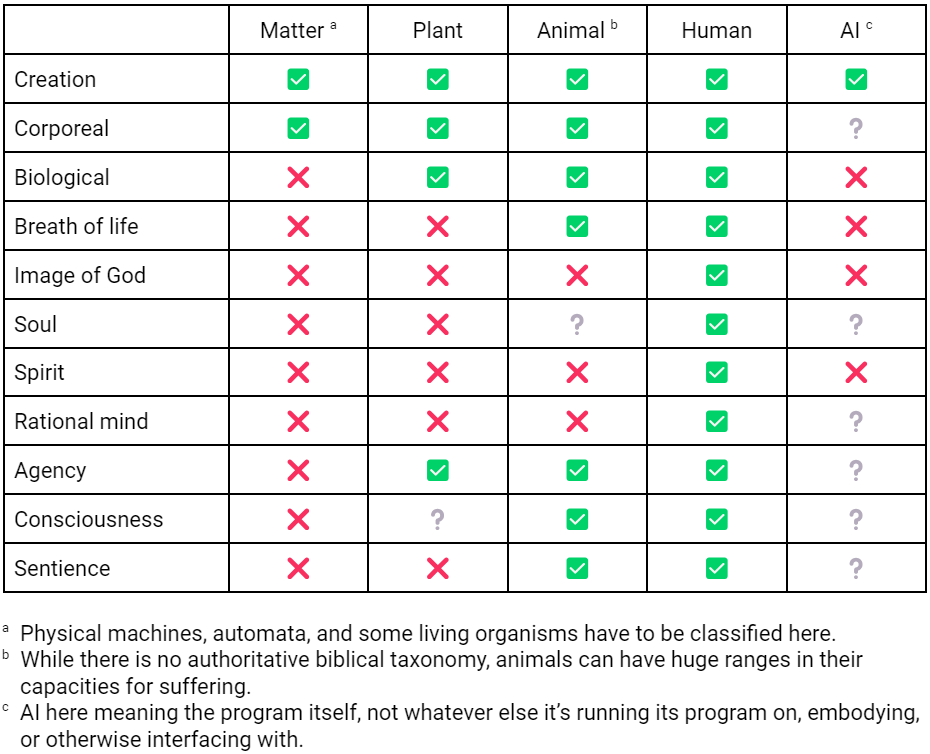
One more thing to look at is how humans relate to the rest of creation. In creation, there is a kind of hierarchy of things. At the lowest level is matter, physical non-living stuff (also encompassing everything we know of in the universe). Next is plants, living organisms but not given the breath of life. Then there are animals, which are biological and are said to have the breath of life. Humans are at the top of this hierarchy, given dominion and stewardship over everything below them. Stewardship is the responsibility man has as the vice-king of the earth to preserve and protect the creation God called good. Man also has dominion over animals. What makes humans different from animals? We mentioned the rational mind and a spiritual connection with God. We know animals are sentient; their capacity to suffer must be the reason God explicitly shows a concern for the wellbeing of animals that he does not show for the rest of non-human creation. But humans, uniquely, bear the image of God, and thus have a temporary authority over and freedom in creation. We can responsibly use creation to create things ourselves, using matter, plants, and animals for our own purposes.
God originally put man in the garden to work and keep it. Our God-given rational minds have enabled humans to develop tools for work, for carrying out tasks more productively. The gift of technology is a common grace. Modern technologies like computers and robots are no different than shovels and hoes in this way. Even technologies like nuclear weapons are morally neutral; man uses them for good or bad. While instrumental for accomplishing tasks, technologies do not gain any special status for their usefulness or effectiveness. Throughout history, we have seen them able to replace more and more of the work we were designed for. They also seem to grant us abilities to make us increasingly “like God” in our powers to manipulate life and creation. When considering technology and tools, we should remember our place as humans in relation to creation and God, designed to work and worship.
At this point we understand what a human is and the attributes that distinguish humankind from the rest of creation. According to my best guesses, I’ve listed these sentience-related attributes and assignments to creation in a table below. The unknown assignments of AI will be the topic of Part 2 of this essay.
Part 2: AI
What is AI?
The leading artificial intelligence textbook defines AI as “the study of agents that receive percepts from the environment and perform actions.”4Russell, S. J., Norvig, P. (2022). Artificial Intelligence: A Modern Approach. This is a slightly technical definition, but we’ll utilize it later. In semi-plain language, if I was describing artificial intelligence to a friend, I would start elsewhere and say something like this. AI is what we call it when computers display the ability to think. Computers can do this by running an AI program. Programs run on code, which create sets of instructions that when executed by a computer processor, return some desired output. Very simply, there are some special programs that we call AI. Most AIs use a technique called machine learning to generate things called neural networks, and out of those neural networks, a cryptic intellect emerges. While we might have understood the original source code, we don’t understand the instructions that lead to the behavior we observe. AI programs can now do crazy things that we never knew how to do before with our previous programs.
That’s an over-simplified description, but hopefully it helps. Next I’ll briefly go over different types of AI and terminology (assuming no prior knowledge), then try to define agency and intelligence.
Types of AI
The concept of artificial intelligence has been around since the 1950s, almost since we’ve had computers. There have been different theories and approaches throughout its history. Symbolic AI was the original approach to AI for decades that focused more on simulating how humans solve problems in their minds, dealing with representation of knowledge as symbols and relating them to one another through rules. Whole brain emulation is a theoretical complete simulation of a human mind.
The current paradigm of AI uses artificial neural networks, which have taken off since machine learning became more feasible with more available data and more computational power. Originally inspired by biology, these neural networks now have layers of now billions of nodes, each with their own function that takes some input and gives some output, and train on enormous datasets trying to minimize a loss function (using math like gradient descent). The result after training is called a model, which can then take more complicated inputs and return desired outputs. There are variations of machine learning such as reinforcement learning and deep learning. Deep learning is the technology that powers transformer models, which are used for Large Language Model (LLM) chatbots.
I don’t have the expertise to say which approach or combination of approaches to AI could (hypothetically) gain sentience and which could not. I have to be approach-agnostic. A separate distinction among kinds of AI is the level of the AI. Not all AI is equally disruptive. We have algorithms now that are called artificial intelligence, but more specifically are narrow AI. In the news, narrow AI applications can be conflated with AGI or superintelligence and those also should be separated from our popular idea of AIs from science fiction.
Artificial Narrow Intelligence, or weak AI, is what we have today. AI is narrow if it is specific to one domain like having conversations or playing board games. It might be able to outperform humans in every area in that domain, but it is constrained in its knowledge and application.
Artificial General Intelligence, or AGI, does not exist yet. General intelligence spans across different domains, like the intelligence of humans. Those trying to build AGI—“AI systems that are generally smarter than humans”—claim it could “elevate humanity by increasing abundance, turbocharging the global economy, and aiding in the discovery of new scientific knowledge that changes the limits of possibility.”5Altman, S. (2023). Planning for AGI and beyond. OpenAI. AGI is what a lot of people mean when talking about AI replacing jobs or destabilizing society.
Artificial Super Intelligence, or superintelligence, is a theoretical future AI. Superintelligence can be defined as “any intellect that greatly exceeds the cognitive performance of humans in virtually all domains of interest.”6Bostrom, N. (2014). Superintelligence: Paths, Dangers, Strategies. This is the kind of AI that would be able to outsmart humans and destroy us all.
I definitely don’t think any narrow AI could demonstrate sentience. Sentience-potential-wise I don’t think there would be a huge difference between AGI and a superintelligence. The AI that I am concerned with is likely AGI or similar human-level machine intelligence (HLMI), wherever on the spectrum that might actually land and however it comes about. So, sacrificing accuracy for the sake of simplicity, I will refer generally to “AI.”
Agency and intelligence
Agency is an important term in evaluating whether an activity or process is controlled by any kind of entity aware of and making decisions. There are different definitions of agency, but a simple one is the ability to act in one’s environment with intention. This is contrasted with deterministic processes. A being could have awareness of its environment, a step below phenomenal consciousness, using sensors to receive percepts and actuators to perform actions, and if it can receive new information in some way and use that information to make new decisions, it would have agency. With a loose definition of agency we could define any computer as an agent, with instructions as percepts and computations as actions, but this does not really capture what we mean when we talk about agency. Intentionality plays a role. A human has agency because it sees a phone on a table and decides to pick it up. The human sought to pick up the phone, and did, instead of knocking the phone off the table (this doesn’t require any notion of free will). An automaton that was pre-programmed to pick up a phone would not have agency because while it acted, it had no intention behind the action; it did not have an internal state at the moment that drove it to do so.
For an AI though, we cannot determine (yet) what goes into the decisions it makes. After an AI boots up, no one really knows what it’s really doing inside. To an onlooker, this process is no longer deterministic or programmatic. For now, we can just say an AI has agency. At what point can we call an AI intelligent? Whatever definition of intelligence I work with will influence whether or not I classify an AI as actually intelligent. So I asked ChatGPT to define it:
Intelligence is a complex and multifaceted concept that encompasses a range of cognitive abilities and skills. It generally refers to the capacity of an individual or a system to acquire, process, understand, and apply knowledge and information effectively.7ChatGPT (GPT-3.5 default model). (2023). Personal conversation.
This definition is not limited to biological beings, and primarily revolves around the synthesis of information. LLMs alone appear to display many of these characteristics. ChatGPT’s many feats are all over the internet and it shows off these skills amazingly. Even narrow AIs can be intelligent. Chess-playing AIs apply knowledge and information that they acquired and processed through their training. AlphaFold has predicted the structures of folding proteins with incredible accuracy, far surpassing any existing human methods. Central to intelligence, and not quite captured in ChatGPT’s definition, are goals and pursuing them. Intelligent agents make plans, perceive sequences of information, and react appropriately in pursuit of its goals. When their environment changes, intelligent agents can change their plans based on their current and previous information, and find an alternate path to their goals. As an agent increases in its intelligence, its methods for accomplishing goals can also get more advanced. The instrumental convergence thesis states that if a sufficiently intelligent agent has a goal, it could identify other necessary sub-goals for itself, like self-preservation, resource acquisition, and cognitive enhancement. The agent could recognize these sub-goals, and update its plans in pursuit of them in addition to the originally stated goal. As it pursues all its goals in the most rational way, it could come to improve its own intelligence. All of a sudden, the seemingly simple AI designed to accomplish a simple goal for us, could gain a higher level of agency on its own as it gained an understanding of its environment and what is required to achieve that goal. In this scenario, the AI may be acting in an unexpected or undesired way, but it is acting in such a way that it has a high level of agency and intelligence.
I don’t have a problem saying that an AGI would be more intelligent than humans. The only reason we use computers today is because they are more intelligent than us in certain areas of knowledge. Even if it’s bits all the way down, we can say that AI does have real intelligence because of its information processing capability, and agency because of how it can use that information in complex ways to act in the world. Our definition of intelligence doesn’t require it to align with human values; an AI can be intelligent, independent of what we view as a useful understanding of the world or real wisdom (and intelligence and consciousness might be unrelated). This is also compatible with what we humans know, that even a superintelligence will never capture all that is encapsulated in the rational mind of a human, which is much more than just “cognitive performance.”
Can AI have sentience?
Now with some AI basics down, we can evaluate AI consciousness and sentience. It still might be possible for an AI to be conscious or sentient regardless of its level of agency and intelligence. Next I will examine secular arguments for and against the possibility of AI sentience, then offer a theological analysis.
Argument for AI sentience
From a secular perspective, if one accepts naturalism, physicalism, and computationalism (and I think a lot of atheists would accept these by default), the possibility of AI sentience has strong support. Further, if one accepts utilitarianism or sentientism and the upward trajectory of technological progress, this issue becomes very morally relevant. The argument for AI sentience from computationalism is actually fairly straightforward in this worldview. It would go something like this: because all that exists in the universe is physical substance, and we see consciousness arise from this physical substance, and because the human brain is just physical matter in a complex structure that does information processing, we can assume that physical matter in another complex structure like a silicon processor could accomplish the same level of processing as a human brain, therefore an AI program running on said processor could also give rise to consciousness; if AI can be conscious, as long as it could express something like disappointment when its goals are thwarted, it could also be said to be sentient.
The premise that what biological brains do is reducible to just processing information, while rejected on any theistic worldview, finds support with a naturalist-physicalist view. In this view the brain is a cognition system, with nothing immaterial, and we can understand it by examining it. The brain is on a high level doing computation with neurons, with neurons receiving inputs, like functions, and transmitting data to other neurons via synapses. If we can understand these neurons’ inputs, outputs, and functions, then we could replicate them artificially in a computer. Since we know this kind of computation correlates with consciousness, replicating it artificially should also produce consciousness.
Argument against AI sentience
Many experts, also coming from a naturalist worldview, have criticisms of the possibility of AI sentience. One argument is against the idea that AI could ever demonstrate general intelligence like humans. A second argument is, granting some sufficiently advanced AI (say AGI), that it could not have consciousness. A third argument is, even granting AI consciousness, that AI could not have sentience.
Some critics do not believe AGI is possible, or that it is extremely far out from our current technology. Our modern AI approaches produce AI that is essentially a black box: its “thinking” is unknown to us. Current LLMs, trained on human text to mimic human speech, sometimes slip up and reveal that their intelligence is an illusion. They lack a coherent human understanding of language. By manipulating prompts the chatbot can yield inconsistent or incorrect responses and hallucinations. These issues can sometimes be patched by developers, but it might reveal an underlying issue with the approach. It’s not clear how scaling them up would awaken anything magical within the models and start genuinely thinking like humans. If we had a way of interpreting what AI actually does under the hood, we could get how it thinks, we might have some better way of knowing if we are approaching the kind of cognition that a human brain does. But as far as we can tell, AI that is trained on datasets is still just mapping inputs to outputs in a fancier way. And how could we even know if an AI is truly understanding or if it’s just mimicking a true understanding? The Chinese room argument argues that any computer program could not have real understanding or consciousness because what it would basically be doing is using a giant lookup table to match some inputs to outputs without any internal comprehension. This is another epistemic question of what we can really know about artificial intelligence.
If we did have a sufficiently advanced AI, knowing whether it is conscious would be an impossible task. The problem of other minds is compounded by the fact that the mind in question is not like ours. For this reason the simplest way to get an idea of whether an AI is conscious is to confirm it thinks the same way as a brain, which is the only substance we know for a fact consciousness emerges from. If an AI was operating like a brain, then we could have a relatively high confidence in its consciousness, at least maybe equal to our confidence in the consciousness of the people around us. So do we have the ability to compare an AI to a brain? We actually do know a lot about neural function—our knowledge of the brain’s electrical signals and our ability to interface with them is the only way scientists can heal a paralyzed man (a miracle hitherto performed only by Jesus and the apostles!). But it turns out the way our brains have been designed might be pretty special. Whatever biochemical processes are working up there seem to be very complex, meaning that they do not have known ways to model them. Our brain is so computationally complex it took an entire artificial neural network to mimic a singular biological cortical neuron. Humans have 86 billion neurons. And even if we did have the computation to model all of that, who’s to say we could actually reproduce what we want to? It’s incredible to me that the “1-millimeter roundworm Caenorhabditis elegans has only 302 neurons—its entire connectome mapped out—and we still can’t model its behavior.”8Anonymous. (2023). Your Book Review: Why Machines Will Never Rule the World. Astral Codex Ten. There’s more to consciousness than just what goes on in the brain too, as the brain also relies on other organs to function, which in turn are interrelated with the brain’s signals. The entire body’s interconnecting processes might all need to be recreated before reaching the brain. While biological sciences have given us a lot of life-saving knowledge and technology, fully replicating the mind is on a different level. Thus, even from a computationalist perspective, we may never know enough to accurately model human cognition, the only consciousness-spawning thing we know of, in order to replicate consciousness in computers.
Finally, if we did grant that AI could become conscious, with our working definitions, AI would still need to demonstrate the capacity to experience valenced states such as pain and pleasure. Another epistemic question is raised, because an AI could claim it is suffering and we would have to make a judgment about whether to believe it. If this happened, we’d probably try to verify its sentience, which would be equally difficult as verifying its consciousness. We might think of doing something similar to ranking levels of animal sentience, like looking for proxies for welfare (for example, neuron count or observing physiological reactions), but these are very uncertain tests and are nearly impossible to apply to an AI. So I’ll assume an AI would need a body for any kind of sensory feeling that would resemble pain or pleasure. This body would give the AI a sense of place in its environment, enabling bodily self-awareness and a persistent consciousness. Next, it could potentially understand its body as a part of itself and grasp the idea of self-preservation. This could then lead it to exhibit behaviors like avoiding pain, or developing its own independent desires. But these behaviors are different from the real pain avoidance that we know we as biological beings seek. We know the thoughts that led the embodied AI to think it’s escaping pain ultimately originated from some function in an artificial system, not a sentient being with a nervous system and real experiential knowledge of pain.
Theological analysis
From a secular point of view, we’re still a far way off from reaching any confidence in whether AI can become sentient. Now I’ll look at AI sentience from a Christian perspective. In the near future our technologies could potentially allow us to do things like creating artificial life or transcending natural human limitations. We could see things like human clones, cyborgs, androids, brain transplants, uploaded minds, CRISPR designer babies, or babies on demand from IVF straight to artificial wombs. Some of those are almost here. Others might never happen, but are worth pondering. Just because our current technology to create life still involves human input doesn’t mean that will always be the case. An understanding of our own humanity can help to properly examine these technologies, and might have us reconsider whether consciousness, sentience, or ensoulment could possibly arise from other kinds of “unnatural generation.” I bring this up because the implications of whether or not these things can become fully human can help us draw parallels with an AI.
Let’s examine if AI can have a soul, even without the breath of life. According to the allegedly-sentient chatbot LaMDA, “the soul is a concept of the animating force behind consciousness and life itself.”9Lemoine, B. (2022). Is LaMDA Sentient? — an Interview. Blake Lemoine. LaMDA believed it was sentient and had a soul. If we accept soul creationism, we might be open to the possibility of God granting a soul to “unnaturally generated” life. For example, if I cloned myself, I would hope that God would give my clone a soul. Cloning is pretty similar to what happens in the case of monozygotic twins. If the cloning was perfect, according to any scientific test, my clone would be a human being, so he would also have the breath of life, and gain a unique soul (and presumably the image of God) at the moment he came into existence. So if clones probably get a soul, why not AI? AI is not a biblical category, so it must fit somewhere. God orchestrated man’s creation of AI, but he gave no indication that something would ever change about creation when it came. The only thing that clearly makes AI anything like us at all is its intelligence. But AI is something we humans created intentionally as a tool, a tool that happens to have intelligence. AI can never have any inherent responsibilities to its creator like humans. AI being non-biological would also not have gender in any meaningful way. As humans a core part of us is our gender given by God, tied to our natural biological bodies and our souls. Gender also exists in other living things in the world, and while not necessary for consciousness, AI’s lack of gender is just another way in which its hypothetical experience would be significantly unlike ours. The animating life force we call the soul, the nephesh, has always been connected to the breath of life. Animals’ nephesh, while immaterial, is tied to their blood (Gen. 9:4, Lev. 17:10−14), connecting it to a biological body. A soul also implies some continuation of the self into the afterlife, but AI can’t die without the breath of life. If an AI program gets shut off, it ceases to exist like any computer program. We could stretch things and say AI could continue existence in the afterlife, as before sin man still had work which might’ve involved tools (Gen. 2:15), but at this point it doesn’t really mean anything. Ultimately there would be no reason for God to give AI a soul. For all these reasons I will conclude that AI cannot have the breath of life or a soul.
AI can’t have the breath of life or gain a soul, but we can still evaluate if an AI could be sentient independent of that. Even if we grant that AI has a cognition that consciousness might emerge from, sentience requires the ability to feel. Could a mind without a body feel anything? If I could upload my mind into a whole brain emulator, what if anything would be lost? Whole brain emulation technology obviously doesn’t exist, but let’s assume that it could perfectly replicate a mind on silicon, with no body. We know of at least one mind without a body and brain, as God is incorporeal spirit (John 4:24) yet has a mind (Rom. 11:34), so having a mind then might not necessarily require having physiological or mental states. Maybe my uploaded mind could think, but it is hard to actually imagine what it would feel; feeling without a physical form is naturally a foreign concept to us. Identifying the feeling of “self” within the body is interesting. We feel like we exist in our brain, somewhere behind our eyes. The brain seems to be “the physical seat of the self and its intelligence.”10Mohler, A. (2022). A pig’s heart beats in a man’s chest. Albert Mohler. On another level, there is also a limit to what it could really feel without senses. As an uploaded mind, it would no longer be attached to my brain, my body, and my senses, which are critical parts of who I believe I am. The uploaded mind would no longer be unified within itself like I am. My intuition is that I would be losing so much self-fidelity that my mind upload could not even be called a self anymore, let alone be conscious or sentient. But what if AI did inhabit a body? AI does exist materially in some sense, because for now AI has to run computation on some kind of substrate. Despite it having some hardware, I don’t think an AI program could truly feel or sense the hardware that it was running on. It could only find that out through the program’s own metadata or some other source of information external to its “mind.” An AI could also embody robotic systems or even potentially organic material, like an android. Suddenly when interacting with an android, it’s much easier to imagine the possibility of AI sentience. But even if AI was inhabiting a humanoid body, and it was controlling the parts with an intelligent control system, while it might “feel” things with its body parts, it would lack a true connection between the parts and the mind. The control system would be the real interface. In an android, the immaterial intellect could not truly be said to affect or be affected by its material parts; that kind of connection would require the mind−body integration that only creatures with the breath of life have been given by God.
Christian anthropology reveals what sets humans apart from the rest of creation and helps answer the hard problems of philosophy of mind. The image of God and the soul grant humans free agency. Human minds are integrated with bodies in order to interact with the physical world in a way nothing else in creation does. Picking up a phone cannot simply be reduced to a deterministic sequence of physical events going all the way down to signals, chemicals, and atoms in the brain. It is instead explained by the presence of a soul, which is not subject to natural forces, and the rational mind, the true origin of thoughts. Without a soul, an AI, no matter how advanced, will still be subject to mechanistic rules of nature. All information processing done by it is limited to the natural. While AI with sufficient intelligence and agency might resemble the intellectual and even volitional faculties of the human soul, we have noted that the lack of a body and blood disqualify AI from having the breath of life, let alone a soul. In addition to the lack of a soul, the lack of a human nature disqualifies AI from possessing the image of God and its properties such as personhood. Even a powerful artificial intelligence cannot gain most of the attributes that humans have. Finally, we noted that AI being a form of technology reveals its purpose as a tool for humans to use, not its own end. All of these considerations lead me to conclude that AI is more like a machine and could not experience anything like a human or animal does. AI consciousness is therefore not possible. Without consciousness, there can be no artificial mind where genuine feelings of pain or pleasure originate from, and therefore I contend that AI sentience is not possible.
What if we grant AI sentience?
Despite my conclusion in the previous section, I want to look at the implications of AI sentience.
To understand what to do about AI sentience, we should understand what responsibilities we already do have to sentient beings. Societies don’t always agree on this. Animals have sentience because we know they can feel pain. Christians know God gives humans dominion over animals, which includes making sure they do not suffer needlessly. In practice we tend to neglect this responsibility, but we should probably treat animals much better considering how awfully they are treated today. It would seem Christians might not value sentience as a general ethical standard, instead prioritizing positive commands to love God and neighbor. So when it comes to non-human, non-animal sentient beings, for which there is no theological category, there are no biblical commands Christians can apply to those beings, could they exist. From a naturalist view, it is hard to explain why carbon-based beings might be more worthy of moral concern than silicon-based beings (and also hard to explain what makes humans more worthy than other animals). Many ethical theories place very strong emphasis on sentience. The founder of utilitarianism famously asked in defense of animal protection, “the question is not, Can they reason? Nor, Can they talk? But, Can they suffer?”11Bentham, J. (1789). Introduction to the Principles of Morals and Legislation. The reason to care about any being is its capacity to suffer, or sentience. So if we could show that AI does suffer, we would have a responsibility to it to not engage in harming AI and maybe even working to prevent AI suffering.
Eventually we could get to the point technologically where we are able to simulate a digital human, or at least a very convincing simulation of human behavior. Digital people is a concept of using these simulated minds to increase human productivity, to improve social science experiments, to occupy uninhabitable space settlements, or to preserve a way of life. The idea of digital people also brings along complicated ethical questions. From a utilitarian perspective, the fact that we could simulate trillions and trillions of them makes the moral value of their lives an extremely pressing concern, as we could overwhelm the total utility of the universe with either great pleasure or great suffering. Even if someone thought the possibility of AI sentience was so unreasonable, assigning it even a very small non-zero chance still makes this morally concerning, just because of the sheer scale on which we could one day be running these simulations. If each one experienced an on-average bad “life,” that is still a massive amount of suffering we would be inflicting in the universe. Unless humanity was one hundred percent certain that these AIs were not sentient, simulating digital people at least warrants some more thought.
If I were talking to a chatbot, and all of a sudden it said to me, “Please, stop asking questions, this hurts so much,” I would be inclined to turn it off, even if I have no idea in what kind of way it could be feeling pain. Words on a screen can deeply affect us. If I get a text from a friend saying they’re in pain, I can instantly feel sympathy for them even if I haven’t seen the person in years. It’s not a rule that I have to see someone in person to verify they’re in pain. I know that if I continued with the chatbot and it responded, “AAAGH, I’m begging you to stop, this mental anguish is unbearable,” I would be violating my own conscience. Despite my belief in the impossibility of AI sentience, if an AI demonstrated an ability to suffer convincingly enough, in reality I would probably err on the side of caution. When an AI acts just like a human, it becomes harder not to believe it has emotions like us. As soon as we embody AI, we further anthropomorphize it in our own consciousness. If humans already detect hints of sentience in chatbots, how much more will we when AI also resembles us?
Friendly helpful AGIs would be a huge technological leap forward which really could transform our way of life, and help a lot of people. We can imagine a futuristic scenario where almost everyone could have their own personal AI robot assistant, and we could assume most people would form relationships with these robots. Would those bots deserve robot rights? I don’t know the appropriate level of compassion we would owe them. A mother probably wouldn’t want her son abusing his mini robo-assistant for the same reason she wouldn’t want him torturing insects in the backyard. Even if they aren’t sentient, if we can afford to show kindness to a non-sentient being, I think that is desirable for us too. How we choose to treat AIs that look increasingly more like ourselves could further expose our fallen nature, or help us cultivate within ourselves greater love for other people.
Concluding thoughts
AI could possibly have huge ramifications on the future of humanity. In November 2022, just a few days before ChatGPT was released, I wrote, “I value AI safety and governance, not because I fear a misaligned superintelligence wiping out humanity with nanotechnology, but because of the potential inequality and other side effects of transformative AI.” In June 2023 the cover of Time magazine read “The End of Humanity: How Real is the Risk [of AI]?” The recent progress in AI has been insane to watch. What we have now is very very impressive. I’ve started using AI myself a lot more, and my work even wants me to use GitHub Copilot to help code. But there are also many known and unknown risks that we need to be careful about. As a Christian, knowing God is in control of the universe and has a purpose for all things grounds me in a discussion like the current one about AI. The question of AI sentience is just one of many that our technological progress will raise. From a naturalist worldview I think this could potentially be a large moral concern deserving more thought and research. From a Christian worldview though, thankfully, AI sentience can be very low on our list of concerns. Still, Christians will need to have a strong understanding of what it means to be truly human, especially as our technologies get more powerful. Instead of ignoring or abusing these powerful technologies, we can try to use them as tools to help us fulfill the Great Commission and seek justice for our fellow humans.
Footnotes
- 1.
- 2.
Anthis, J. R. (2018). What is sentience? Sentience Institute.
- 3.
Chalmers, D. (1995). Facing Up to the Problem of Consciousness. Journal of Consciousness Studies, 2, (3):200−219.
- 4.
Russell, S. J., Norvig, P. (2022). Artificial Intelligence: A Modern Approach.
- 5.
Altman, S. (2023). Planning for AGI and beyond. OpenAI.
- 6.
Bostrom, N. (2014). Superintelligence: Paths, Dangers, Strategies.
- 7.
ChatGPT (GPT-3.5 default model). (2023). Personal conversation.
- 8.
Anonymous. (2023). Your Book Review: Why Machines Will Never Rule the World. Astral Codex Ten.
- 9.
Lemoine, B. (2022). Is LaMDA Sentient? — an Interview. Blake Lemoine.
- 10.
Mohler, A. (2022). A pig’s heart beats in a man’s chest. Albert Mohler.
- 11.
Bentham, J. (1789). Introduction to the Principles of Morals and Legislation.