AI and The Abolition of Man: an experimental comic book review and a reflection on our present crisis
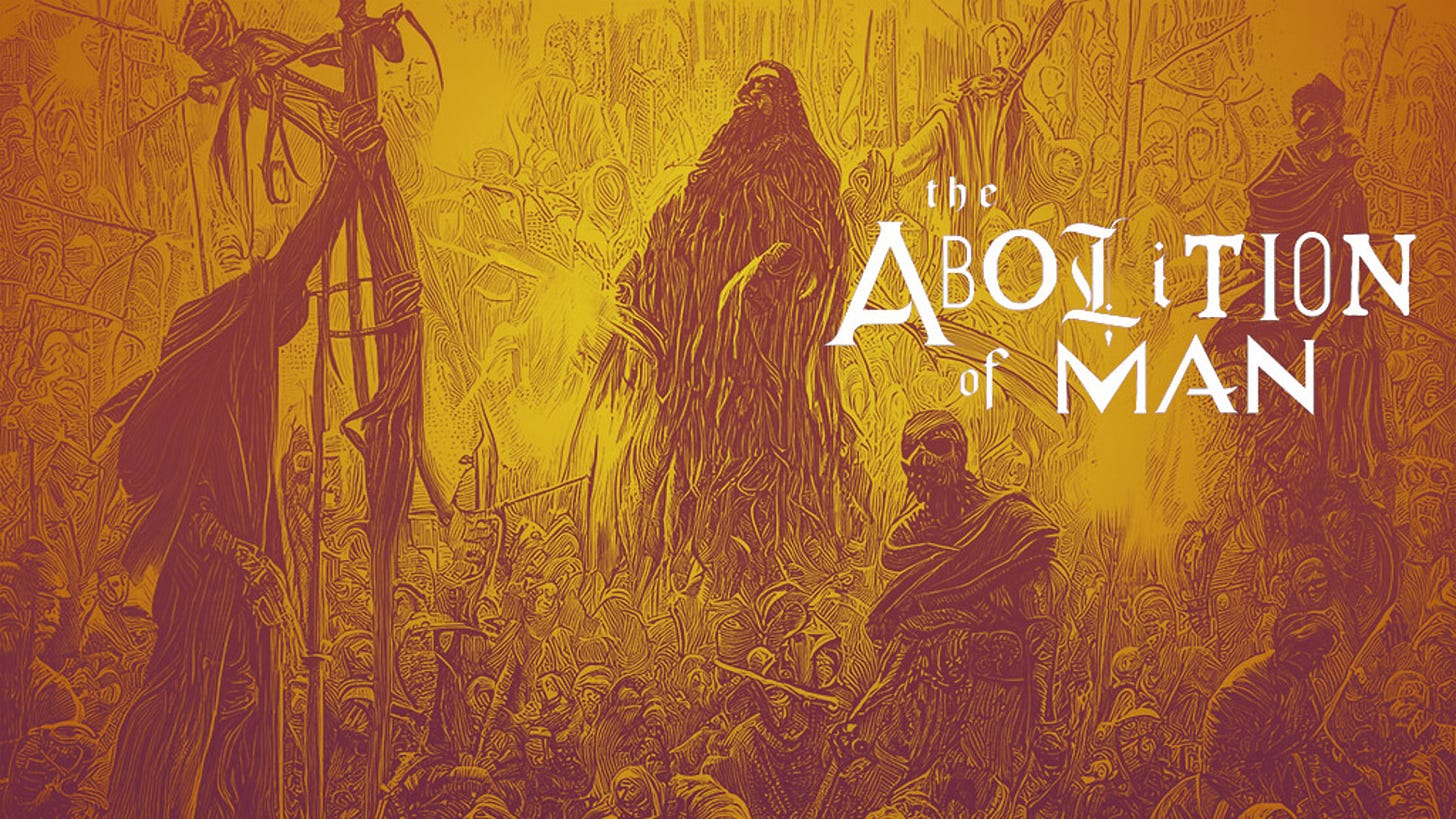
Carson Grubaugh, Midjourney AI, Sean Michael Robinson, and Luciano Floridi, The Abolition of Man: Deluxe Edition (St. Paul, Minnesota: Living the Line, 2023). 228 pages. $35.00.
I think my favorite genre of article is the book review. As a Substacker, my favorite book reviews are those that Scott Alexander posts on his blog Astral Codex Ten (ACX). He also posts others’ anonymous book reviews and hosts a competition where his readers vote for the best book review for a cash prize. ACX book reviews live online, so they can have images and hyperlinks and footnotes, and they can be much longer than your typical book review. My favorites are those that nominally start off discussing the book in question, but then go meta and take many twists and turns and by the end are waxing poetic about the meaning of life. This is my attempt at an ACX-style book review. So prepare for some rabbit holes!1Some might say that long tangents are a sign of bad writing, but that’s my favorite part of those reviews. So apologies if you’re not used to it. If you just want my review of the main comic, you could technically skip parts 6 through 2. For just my philosophizing on AI, you can skip to after the image of Lao Tzu (or this link).
One of my favorite ACX book reviews also happens to be a review of comic books (all of Marvel Silver Age comics).2No relation to this other book review of the book written by the guy that read every single Marvel comic book ever published. Sounds like an interesting book though. That review started like this:
You are a serious person with serious interests. The last comic book you read was more likely by Bryan Caplan than Jonathan Hickman. You would prefer to be reading high quality book reviews on [ACX]. You believe ACX book reviews are usually more insightful than the books themselves, and a far more efficient use of your time. But even book reviews take time to process, and there are a lot of book reviews to read. Why spend your valuable time reading an 11,000 word review of superhero comic books?3Edward Nevraumont, “Your Book Review: Silver Age Marvel Comics” (2024).
I guess that gives you an idea of what the average ACX book review writer believes is the standard of the average ACX book review reader. Luckily I am not actually writing this for ACX. But I would like you to read this book review, even if I’ve somehow made it sound more intimidating than it really is. (This post is about 13,000 words.)4Substack estimates this post takes an hour to read.
I grew up reading the book reviews that my dad would clip out of his paper Wall Street Journal and leave on my desk. Sharing news articles is my dad’s love language. Even today, our Messenger chat history is 90% just links that we send one another. When I’m home I’ll see him start his day reading the New York Times app on his iPad while eating breakfast, then transition to reading the paper Wall Street Journal that’s delivered daily, then after work unwind on the Google News or New York Times apps. We used to have stacks and stacks of old newspapers lying around the house.5I like to poke fun of my dad for this—one of my favorite The Onion skits to share with my family is “How Will The End Of Print Journalism Affect Old Loons Who Hoard Newspapers?” For all his love of reading newspapers, he never really read books. One time I mentioned this to a friend, and she replied with something like, “that’s because he likes to make the connections between data points and construct the big picture narratives for himself over time, not just be told them by others through books” and I like to think that’s true of many news junkies.6Because of my dad I’m also a recovering news junkie (or, ex-infovore). Now I feel that longform content on Substack or in magazines is better than traditional news.
The other thing growing up with newspapers did was it got me hooked on comic strips: Baby Blues, Pearls Before Swine, whatever else the San Jose Mercury News had syndicated.7Some other favorites: Mutts, Get Fuzzy, The Far Side, Zits, Garfield (but only the old Garfield). And it’d be criminal to not mention the entire Calvin and Hobbes collection. My love of comic strips then led to me gravitating toward graphic novels in school. In elementary school, I read Bone and Mouse Guard. In middle school I read Maus, which was my first time reading a mature comic. Then in high school I got really into Marvel and DC. There was a comic book store right across the street from my high school. The first individual comic book I ever bought was Batman: The Long Halloween #1. I went almost every Wednesday after school to pick up new comics. I also became a huge nerd—the kind of kid that actually read comic book reviews on sites like Batman-News.com and Comic Vine. And hey, now I am writing my own comic book review!
Okay, so that’s probably enough autobiography to get into the actual review. This book review is about The Abolition of Man: Deluxe Edition by Carson Grubaugh, Midjourney AI, Sean Michael Robinson, and Luciano Floridi. The book is a graphic novel adaptation of the C.S. Lewis lecture called “The Abolition of Man.” (From here on, I will refer to the graphic novel as TAOMDE to avoid confusion.) The unique thing about this graphic novel is that it claims to be the first AI-illustrated comic book.8“Experimental” in my title has two meanings—the graphic novel itself is experimental, and this book review is also experimental (for me).
TAOMDE was released two years ago today, when AI image generation was going mainstream. There aren’t many reviews of the book online.9This one from The Comics Journal is good. As of this review, it only has 5 reviews on Goodreads (and an average rating of 2.8 out of 5 stars), but I feel like some of the reviewers miss the point of the book.
First, I’ll need to explain a bit more about what the book really is…
At first glance the book seems a bit self-serious. It’s a fancy, deluxe-looking book (it does cost $35). The printing on the spine and back uses embossed gold lettering on the maroon faux leather cover. On the top of the back cover it says, “THE WORLD’S FIRST A.I.-ILLUSTRATED COMIC RETURNS IN A DELUXE HARDCOVER EDITION.”10Carson Grubaugh, TAOMDE / The Abolition of Man: Deluxe Edition (St. Paul, Minnesota: Living the Line, 2023), back cover. I find it curious that Lewis’s name is not on the front cover, and somehow not on the back either, considering it literally uses the same name as his book. The volume collects five individual comic book issues, and includes some deluxe additional content at the end. (In comics, issues are typically around 30 pages, while collections of issues are called trade paperbacks or more generically graphic novels.11I only have one physical individual issue of the series, the first one. I thought maybe it would increase in value, but so far it hasn’t really. ) The table of contents at the beginning is pretty useless (the book has no page numbers), since it describes four “parts,” but really it’s more accurate to say there are six distinct components of the book (which also for Kabbalistic reasons is more fitting12Six is the number of man. ):
- The Abolition of Man (Issue #1)
- HodTech (Issue #2 & Issue #3)
- Maria’s Story (Issue #4)
- “On Human Dignity as a Foundation for the Right to Privacy” (Issue #5)
- Pranay Day preview and DALL·E 2 variant (Additional Content)
- “Information” and “The Ethical Obligations of a Banal, Content Apocalypse” (Essays)
My plan for this review is to work backwards through these six components.
6. Essays
The last pages of the book are Carson Grubaugh’s personal writings. There are two essays, both on the philosophy of information. One is an essay called “Information” that he says he wrote in 2007. The second is a sort of Frankenstein of three of his other writings: a 2016 essay, a 2014 journal article, and some previously-unpublished writings on “Esthetic Theory” into one new essay, called “The Ethical Obligations of a Banal, Content Apocalypse.”
The first essay, “Information,” is pretty interesting, but as Grubaugh admits, kind of just his ramblings. One thing I found somewhat useful is his comments on “informational substructure.” He writes:
Existence, then, consists of both the abstract information in the substructure as well as the embodied information of actuality. With this view of existence, it might be easier to understand puzzling concepts like time and the mind-body divide.13Carson Grubaugh, “Information” (2007).
As a Christian whose faith and worldview relies on scriptures, this interests me, as it relates to the metaphysics of scripture. The Bible, and more specifically the Hebrew and Greek characters physically marked on the original manuscript autographs, are the abstract—or, in Thomistic terms, accidental—bits of information. The “embodied information of actuality” is the objective truths that result from the proper understanding of them (like that God created the world). Scripture is the inspired word of God. It was written over a long period of time by human authors, so that the substructure (the autographs) is varied, yet God guided humans over that period so that ultimately the truths would transcend it. The Bible I can hold in my hand and read in my language accords with the same eternal truths that existed before the creation of the world.
Grubaugh also talks about different types of information—true information, false/misinformation, fictional information, and pure information. I won’t go over it all, but I was curious how it connected to a concept called “epistemological limbo,” a term I encountered reading Hans Madueme’s book Defending Sin while I was writing an article on science. Madueme basically questions Galileo’s hermeneutic of reinterpreting scripture in light of new scientific evidence:
Galileo was a heliocentrist, but it is not clear whether he thought his arguments were demonstrably true, nor does he make clear how one should distinguish “demonstrative” scientific proofs from merely speculative theories. The ambiguity lies in the fact that Galileo and his critics falsely believed that investigating nature could yield absolute certainty when, in reality, natural science is inductive and generates arguments with different degrees of strength. Galileo and his critics accepted Aristotelian epistemology—namely, that the physical sciences secure “conclusions [that] are true and necessary and have nothing to do with human will.” If true science yields certainty, this leaves “undemonstrated scientific claims (including heliocentrism at that time) in a sort of epistemological limbo.”14Hans Madueme, Defending Sin: A Response to the Challenges of Evolution and the Natural Sciences (Grand Rapids, MI: Baker Academic, 2024), 16.
So epistemological limbo applies to some claims which we are unsure of the status of their information type—maybe they’re in a quantum-like state between true and fictional information, until more can be known. But I don’t see this issue of epistemological limbo as quite such a serious issue as Madueme does. It’s impossible to avoid, especially in religion. There are examples of certain doctrines that many Christians have differing opinions on, but ultimately agree to disagree on non-gospel issues. There are also other theological things, like the inspiration of the longer ending of Mark, which can be debated among Christians. And there are historical things, like how long it took God to create the world, that we may never be able to know. All of these certainly must have “true” answers. Credobaptism and paedobaptism can’t both be true. Mark 16:9–20 can’t be inspired and uninspired. God had to have created the world in some finite non-zero amount of time, but our scientific estimate might change. It seems to me that “epistemological limbo” is fairly common.
Grubaugh’s application of the substructure idea to both time and the mind–body problem are both interesting. The rest of the essay is kind of a reflection on metaphysical questions like universals and particulars.
The next essay, “The Ethical Obligations of a Banal, Content Apocalypse,” is much longer and more structured. It starts with a reflection on “meaning” and what we mean by it, and how it is conveyed. He describes “gleaned meaning” as the unintended meaning that is received by an audience of a piece of artwork, when it is not necessarily the intended meaning of the author. Grubaugh then moves on to his theory of esthetics, inspired by Luciano Floridi. One quote:
Human agents, as beings uniquely capable of engaging in semantic behaviors, then, appear to have a categorical, ethical commitment to preserve the integrity of the Infosphere by not only halting further entropy but also by engaging in poietic, entropy-reducing, meaning-generating activities.15Carson Grubaugh, “The Ethical Obligations of a Banal, Content Apocalypse” (2016).
Basically: let’s not fill the Internet with slop! The essay continues with a bunch more philosophizing about the limits of randomized content generation. To be honest I mostly lost interest near the end of the essay, and I couldn’t help but think it was maybe due to the exact phenomenon he describes. My attention span as a Gen Z’er is pretty low. I try to read, but the temptation to open up YouTube and have an endless supply of videos tailored to my exact interests is just an arm’s length away. My feed is engineered by an AI algorithm to get me to scroll for as long as possible.
5. Additional Content
Pranay Day seems out of place in this book—honestly, it doesn’t belong at all. Just the textbook definition of a shameless plug. It’s an 8-page preview of a new story by author Carson Grubaugh, illustrated by AI, about a kid named Pranay who is stuck in a Groundhog Day loop. I don’t really know much else about it, since it seems to have been a Patreon-only thing. It was, at the time I guess, a planned interactive project where Carson’s supporters on Patreon supposedly were able to suggest how Pranay can escape the loop. There is a QR code on the page that is supposed to link to Patreon, but today it’s basically a dead link, since the creators seemingly took down their Patreon. I found an archive of the original Patreon landing page, and found that for $5 a month, Patrons got “the right to vote on story suggestions for Pranay Day - A Patreon Exclusive web-comic experiment that is a spin off of the HodTech story from The Abolition of Man.”16From the archived page here: https://web.archive.org/web/20230123002405/https://www.patreon.com/livingtheline. (More on HodTech in a bit).
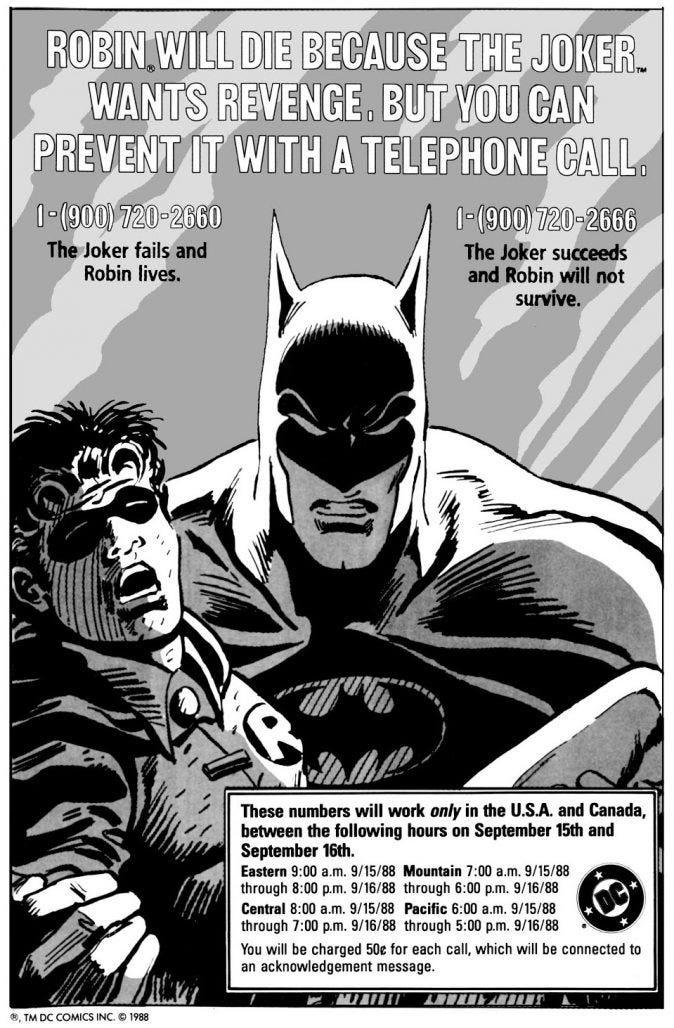
For some reason this reminded me of a 1988 Batman comic book storyline by Jim Starlin called “A Death in the Family” where the fate of Batman’s sidekick Robin (Jason Todd) was placed in the hands of readers. In Batman #427, Joker beats Robin almost to death. On the back cover, readers were told they could call in to one of two numbers—one if they wanted him to live, the other if they wanted him to die—whichever number received more calls, that event would play out in the next issue. Readers could directly influence the canon. Over 10,000 calls were made, and ultimately, by only a margin of 72 votes, readers voted to kill off Robin. And in the comic world where characters die and resurrect constantly, his death lasted—the character didn’t return for 16 years, when he came back as the Red Hood.17In 2020, Batman: Death in the Family was made into an “interactive” animated movie. I never played it. In that movie/game, the viewer can make choices (I assume through a similar mechanism to the old DVD menus or something) that influence the story. For example, if Robin dies, then the events of the 2010 movie Batman: Under the Red Hood play out.
Speaking of death—the dead QR code. It is a strange thing to be reading a physical book and then end up reflecting on link rot. Link rot is the issue of hyperlinks breaking. Someone might link to a good article on a webpage, but in a few years, when that link is clicked, the link is dead, rotted away, a 404. I’ve been concerned about link rot for a long time—as someone who has written articles online, it’s frustrating because I don’t want my readers to have to search for a working readable page.18One organization working to combat link rot is the Internet Archive. I was able to find the Patreon through the Internet Archive’s tool called the Wayback Machine, which archives webpages, so that even if a link no longer works, someone can paste the link into the Wayback Machine and see what the page looked like on a certain date. Link rot is an interesting problem to me because the hyperlink is the foundation of the modern web. In 1989 Tim Berners-Lee developed HTTP (HyperText Transfer Protocol) and HTML (HyperText Markup Language) at CERN which became the World Wide Web. Hypertext is “text which is not constrained to be linear … which contains links to other texts” (hyperlinks).19W3C, “What is Hypertext?” Before Berners-Lee, there was also Father Roberto Busa, the Jesuit priest who “invented” hypertext, although it might be more accurate to call him its “spiritual father.” In 1946 Busa began working on the Index Thomisticus, a concordance of all of Thomas Aquinas’s corpus, allowing non-linear text traversal. It was the first real hypertext project before hypertext. Later in the 1960s, Ted Nelson coined the term “hypertext” and created the first hypertext project called Project Xanadu. Apparently Project Xanadu’s administrators today call out the World Wide Web, which “trivialises our original hypertext model with one-way ever-breaking links and no management of version or contents.”20Quote from the project’s mission statement according to the Project Xanadu Wikipedia page, accessed August 25, 2025. (Although from a Google search this quote might be a case of citogenesis.) (Project Xanadu uses xanalinks instead.) Hypertext would go through several iterations before Berners-Lee’s HTTP and HTML combo. Berners-Lee’s WWW took off and obviously became the massive information system that everyone knows. It’s just unfortunate that we still run into the problem of ever-breaking links.
Anyway, the Pranay Day story almost seems promising. The fan interaction could have been really interesting; I am also a big fan of non-linear storytelling like in Christopher Nolan’s movies. But there’s almost nothing that happens in the 8 pages besides Pranay waking up twice, so as a preview it really doesn’t accomplish much.
As for the “extremely rare” DALL·E 2 variant… I mean it’s fine. I’ll discuss more about the AI artwork in general in a later section.
4. Floridi’s Essay
Next up is an essay by Luciano Floridi called “On Human Dignity as a Foundation for the Right to Privacy,” illustrated with AI-generated art. Floridi starts by examining the European Union’s well-known General Data Protection Regulation (GDPR), and then discusses the basis for a right to privacy.
Privacy has been a pretty hot topic for a while, and especially so right now. As I write this in August 2025, there is an army of Clippy profile pictures amassing on the front lines of the Internet, protesting unethical practices by big tech. I also see a lot of people online mad right now over the UK’s Online Safety Act, which among other things, requires encrypted messages to be scanned for CSAM when technically feasible. In my state of Texas, there is controversy over age verification laws that attempt to prevent kids from accessing adult content online. People are usually pretty skeptical of these types of laws, with a lot of comments online saying things like “they’re only using child safety as an excuse.” Terrorism was the excuse for the PATRIOT Act, but most now think that the government overreached with that.
As contested as these issues are, and as much as you can debate the merits of some law or intervention, I think Floridi puts it really well:
Privacy is to be protected because of human dignity, which is to be protected because of human exceptionalism, which is to be explained and defended by a specific philosophical anthropology, which in its turn is in need of a justification. When people disagree on privacy and on what human dignity means, one can now see that they really disagree about which philosophical anthropology should be endorsed.21Luciano Floridi, “On Human Dignity as a Foundation for the Right to Privacy” (2016).
Exactly. Floridi then reviews the philosophical anthropologies of Greek and Roman philosophy, Christian philosophy, modern philosophy, and post-modern philosophy, but criticizes the fact that they are all anthropocentric. He says that really, dignity is rooted in our free will as agents in the world. He calls his view the “anthropo-eccentric approach” and says only it “can provide an interpretation of human exceptionalism that is sufficiently robust to justify the protection of privacy via the concept of human dignity.”22Floridi, “On Human Dignity.” I guess as a Christian and Calvinist I might have a more direct explanation for human dignity rooted in the imago Dei, which also happens to involve virtue and community within it. To explore this, we can turn back to Texas, where privacy is on the mind. In the oral arguments of the Free Speech Coalition, Inc. v. Paxton case that ultimately upheld the Texas law requiring age verification, a lot of the focus was on the First Amendment and the right to privacy. But what happens when one “right” we have as American citizens conflicts with the common good? You can argue the empirical question about whether on net, porn is good or bad for society, but assuming it is, the real question is what to do about it. We could also look at gambling, which Texas mostly bans. Online, lots of people recognize the dangerous effects of gambling on both the individual and societal level. I constantly see commenters chastising YouTubers who take gambling sponsorships. To Christians, both porn and gambling are vices. It’s just that one is more socially acceptable (at least, for adults). But from a Christian perspective, they should really both be discouraged. Whatever the government does, morality is being legislated. If neither porn nor gambling is outlawed, then the morality being imposed is an individualistic libertarian ethic. If one is outlawed and another is allowed, it’s kind of a hodgepodge capitalistic ethic. If porn and gambling are both outlawed, then the morality being imposed is based on a Christian ethic. But no matter what, the state is taking a side morally. The question is just where does that morality come from? That’s where Christians in government can just be honest and say, this is Christian ethics, because Christian anthropology is true—debating privacy concerns won’t go anywhere unless Christianity is proven false.
I have a complicated relationship with the subject of privacy. At various times in my life, as a kid who grew up in the Silicon Valley in the 2000s, I have been obsessed with online privacy rights. I remember having strong opinions on net neutrality back in the day. I’ve used VPNs, torrenting, encrypted messaging, Linux, Tor, crypto. But ultimately at some point a few years ago I realized I was kind of idolizing privacy, and decided to take a more holistic Christian view of it. Floridi attributes to Augustine the idea that “good persons have nothing to hide, to God or to others.”23Floridi, “On Human Dignity.” That’s kind of the “normie” position but I guess that’s basically where I stand for now.
![Actual actual reality: nobody cares about his secrets. (Also, I would be hard-pressed to find that wrench for $5.) [From https://xkcd.com/538/]](/writing/ai-and-abolition-of-man/45821f3b-c6ff-4d91-805a-461d3a3a84d8_448x274.png "Actual actual reality: nobody cares about his secrets. (Also, I would be hard-pressed to find that wrench for $5.) [From https://xkcd.com/538/]")
3. Maria’s Story
I don’t understand Maria’s Story. Apparently Grubaugh put just the phrase “the abolition of man” into an AI tool called deepstory.ai and it generated an entire script based on those four words, which he then fed sentence by sentence into Midjourney for the images. So this was an entirely AI-generated comic book. The result is horrific. It borders on body horror. The script is available here, but honestly even the text alone is nonsensical and distressing. I think that’s pretty much all I have to say about this. Yes, it is the perfect visual representation of “the abolition of man,” but at what cost?
2. HodTech
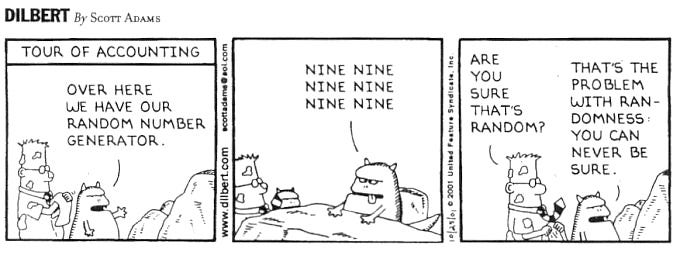
HodTech is an old idea of Carson Grubaugh, and coauthor Sean Michael Robinson helps complete the story (it’s a two-parter). It also uses AI art. The story takes place in a kind of dystopian nightmare world. People brush their teeth with “toothworm,” eat “mignon paste,” and use a kind of newspeak—man is “mas,” woman is “fem,” all personal pronouns are “sun,” and God is “Hod.” The story follows Jasper, who works for the HodTech corporation. Their mission is to ’mute (short for transmute) old paper data into new data in ways that the mysterious HodBots can’t. The “data” are things like “a complete run of Singaporean parking tickets” or “time-applied, mapped extinct Avarian migratory patterns.”24Carson Grubaugh, HodTech, Part One (2022). I found some of the ways that they try to ’mute this data amusing. “What if we took each form and licked it. Then catalogued the memory that attended the licking?” “Or, we could crumple each form, while recording the audio. Then play the recording at different volumes, while noting your heart rate.”25Grubaugh, HodTech. They made me think of the methods in which random number generation is accomplished. Most digital randomness is only pseudo-random because they rely on some formula to simulate randomness. Random.org has a good explanation of this, and how they solve this problem by using physical atmospheric noise, which is a chaotic system and its data can’t be replicated on demand.
The purpose of Jasper’s job is reducing entropy in the world, by hoping that the random transmutations he finds might result in meaningful order. If it weren’t for him, that old unused data would spiral into disorder, increasing entropy endlessly. In a relatively abrupt ending though, Jasper becomes disillusioned with his job, starts a revolution, and then kills all the coworkers that join him. Finally, he calls his brother looking for a construction job.
The main question raised is, I think, do we need meaning in our lives to keep going? Is it possible to continue in life in a soul-crushing job and in a society where no one cares about anything besides money and getting by. The world Jasper lives in is apparently one with “No Need! No want! No poetry!” But for him, obviously it was not enough. He needs purpose, but the story doesn’t provide a clear answer for how to achieve this. Maybe Grubaugh is hinting at his answer in the epigraphs of both issues, which are Ecclesiastes 1:3 and Proverbs 6:6, respectively.
What profit hath a man of all his labour which he taketh under the Sun?
Go to the ant, thou sluggard; consider her ways, and be wise.
1. THE ABOLITION OF MAN
I feel like I should start off by explaining my familiarity with C.S. Lewis. I’ve sometimes felt like a bad Christian for not having read much of his work (I was more of a Tolkien fan growing up). When I was young I didn’t like reading much, besides comics. I did read The Lion, the Witch, and the Wardrobe and watched the movie. But that’s pretty much it as far as The Chronicles of Narnia goes. I remember there was a copy of The Voyage of the Dawn Treader on a fancy pedestal in my elementary school library, and it having this mythical je ne sais quoi about it, but I never read it. I always thought, maybe one day. One day I’ll meet Reepicheep. Maybe I’ll read the Narnia series with my kids like my dad read The Lord of the Rings with me.
Okay, fast forward to college. Week one of my freshman year, I reconnected with an old friend who I used to play Magic: The Gathering every day at lunch with in middle school. We got lunch, then he told me he was checking out different fraternity rush events. I told him I’d join him at the next one. When I arrived, right outside Swig Hall, I found a bunch of guys playing Spikeball. Turns out they were a part of a Christian fraternity, and were so friendly that I attended the rest of their rush events (at this point I wasn’t a Christian). I decided to pledge, and during the pledge process, I was confronted with the reality of my sin and how I did not actually know what the gospel meant. I met up with my big bro in the fraternity regularly, doing Bible studies with him and learning what being a Christian meant. At some point during that pledge process, God saved me. I dove headfirst into theology and immediately started wrestling with things like predestination and baptism. Reading books for the first time became really fun to me. That freshman year became a time of rapid, intense growth as a new Christian. The following summer I lived at home and worked for a local church. I learned about my public library’s partnership with Hoopla, and the first thing I borrowed was The Screwtape Letters on audiobook. One weekend my family took a short road trip and I listened to the whole thing (although I might have also nodded off a bit). Around that same time I discovered Greg Morse’s Desiring God article series The Globdrop Letters (modeled after Screwtape’s letters), and I found them some of the most penetrating, convicting things I’d ever read.
Fast forward again to junior year, and I’m chaplain of the fraternity. I got a little bro, too. I decided to read Mere Christianity with him over the course of a quarter. I remember reading it very closely and taking notes, and we both really enjoyed it.
Fast forward to now. Unfortunately that’s all I’d really read of Lewis.
Before turning to TAOMDE, let me also say some things about C.S. Lewis’s original The Abolition of Man. In 1943, Lewis gave three lectures at the University of Durham on the topic of education. The lectures were titled “Men Without Chests,” “The Way,” and “The Abolition of Man.” They were turned into the three chapters of the 1943 book The Abolition of Man. The subtitle of The Abolition of Man is: Reflections on Education with Special Reference to the Teaching of English in the Upper Forms of Schools. (So, “The Abolition of Man” [in quotes] is the lecture, while The Abolition of Man [in italics] is the book. And TAOMDE is the graphic novel.) The 2015 HarperCollins paper edition of The Abolition of Man (with all three chapters, and notes and an appendix) is only 128 pages. For a very simple summary, The Abolition of Man first starts with a defense of “objective values” over what we might call relativism or subjectivism, specifically in education. Then he moves on in the second chapter to describe “the way,” or the Tao, as the set of objective universal moral laws undergirding all cultures (which is detailed in the appendix). Finally, in the third chapter Lewis presents a dystopian future where man has abandoned the Tao and pursued science and progress without objective values as a guide.
TAOMDE actually only utilizes the text of the third lecture/chapter, “The Abolition of Man,” so that is what I will focus on.26The text of the “The Abolition of Man” lecture is actually not that long, only about 5,600 words. This book review alone is more than double that length. Obviously, the selection of that last chapter, “The Abolition of Man,” to be the first AI-illustrated comic book is supposed to be tongue-in-cheek, as the whole generative art kind of plays into the central idea of man going too far with science and technology. I guess that irony is supposed to be explicit enough that it is never really pointed out. The art was generated by Grubaugh himself using an AI tool called Midjourney. He fed each individual sentence of Lewis’s essay as its own prompt, and then chose the most fitting image from among them.27Midjourney is accessed through the social media app Discord. I’ve used it before and it’s good, but this makes it somewhat difficult to use. Usually it spits out four distinct images per prompt for you to choose from, which is what Grubaugh did. And from the looks of it, the only modification was then to overlay the sentence text on each panel for readability.
One small issue I have with the format is the use of standard comic book text in all upper case (this is relatively common with comic books, but nowadays you see sentence case used a lot too). Grubaugh did not transfer over capitalization nor italicization (for emphasis or Latin phrases) that would clarify the text. There are also a few typos and missing quotation marks, but nothing that makes it too hard to read. From the looks of it, the text was not lettered by hand, but a comic book font was used digitally. So I do question whether Grubaugh actually re-read everything for clarity, because there are places like this where the text is unclear.
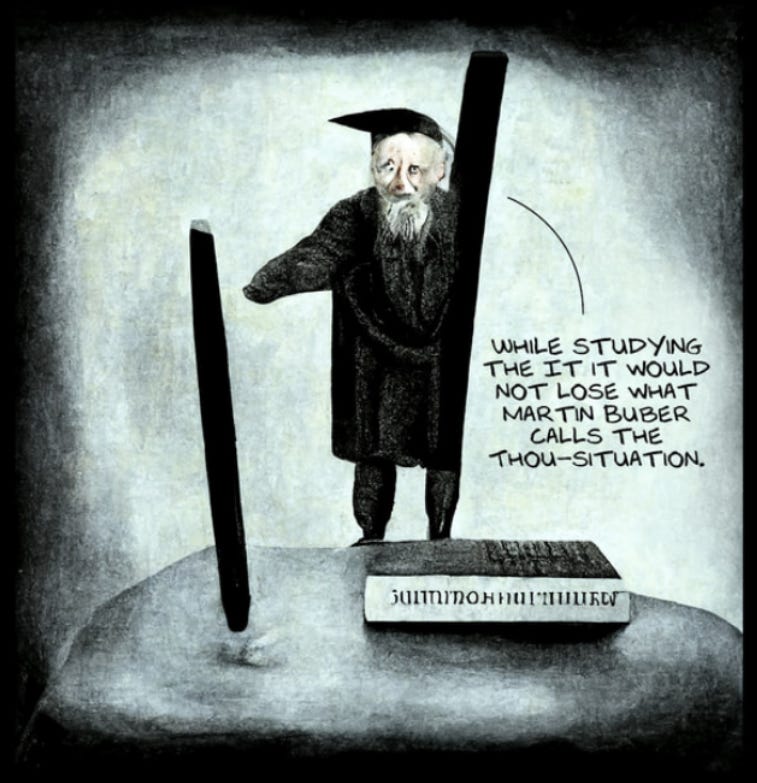
And here are the panels preceding the sentence in question.
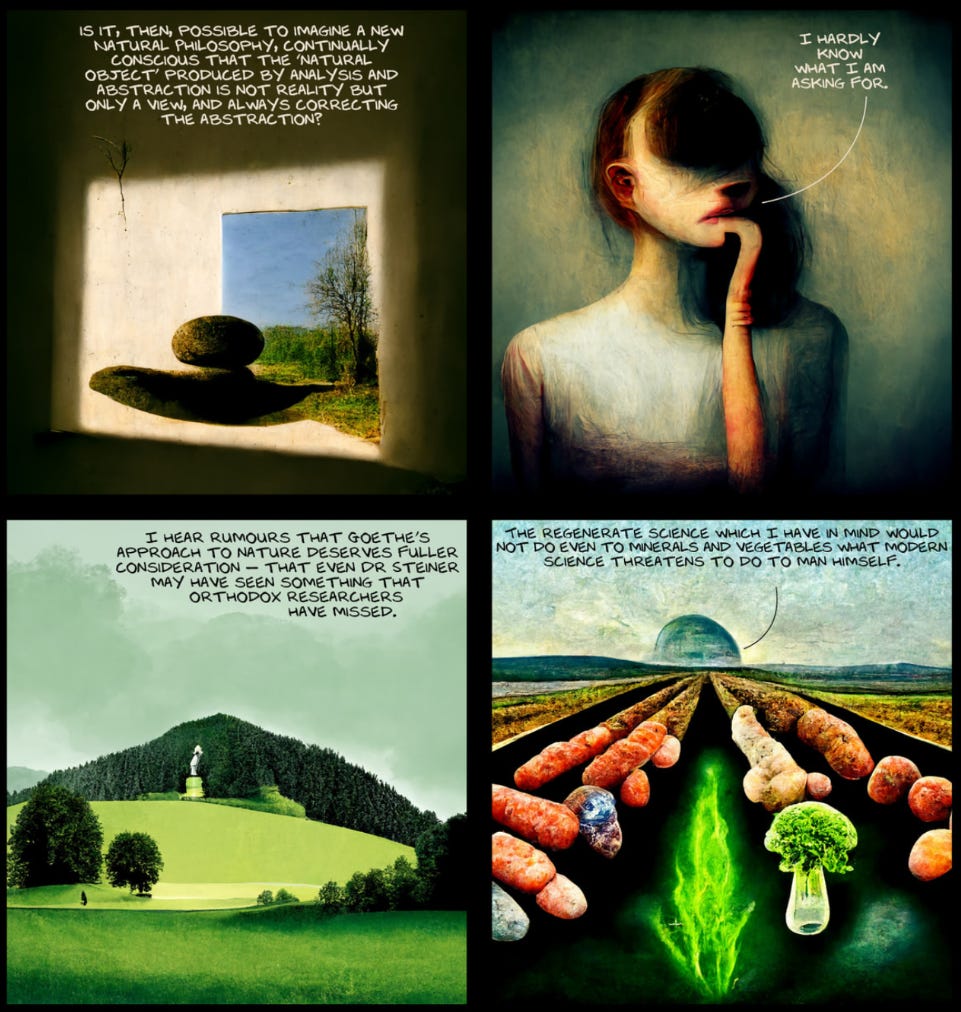
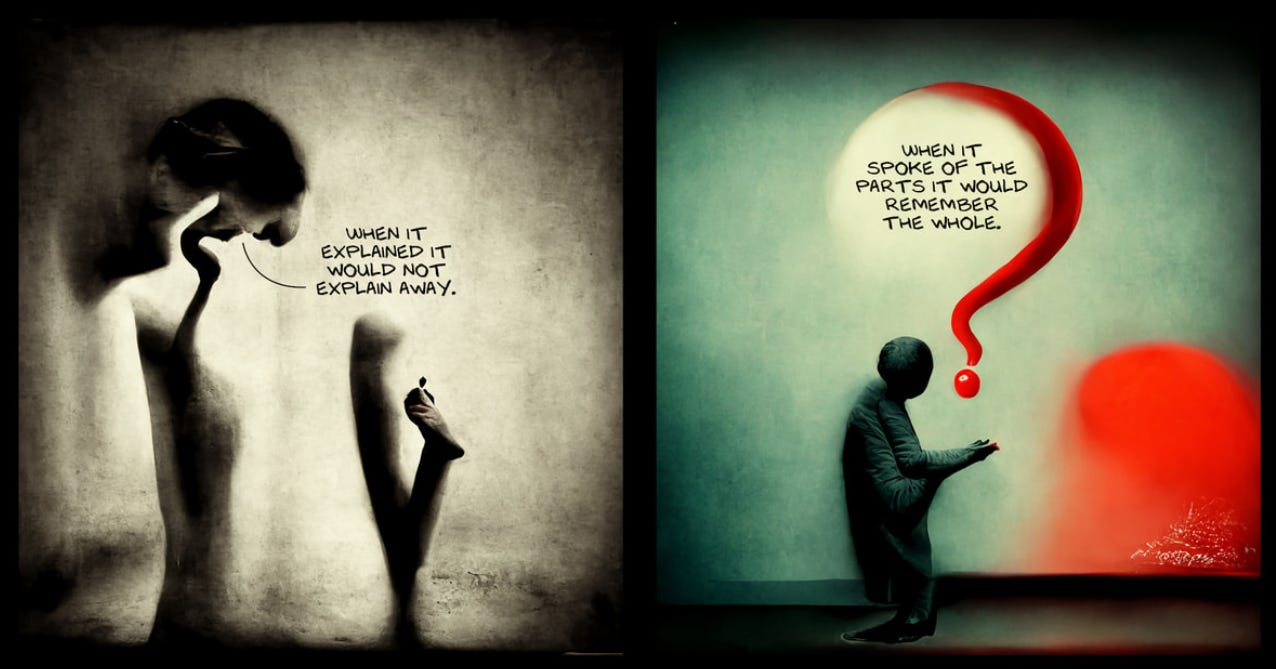
Here is the whole paragraph from my HarperCollins edition with the other panels’ text included (emphasis original):
Is it, then, possible to imagine a new Natural Philosophy, continually conscious that the ‘natural object’ produced by analysis and abstraction is not reality but only a view, and always correcting the abstraction? I hardly know what I am asking for. I hear rumours that Goethe’s approach to nature deserves fuller consideration—that even Dr Steiner may have seen something that orthodox researchers have missed. The regenerate science which I have in mind would not do even to minerals and vegetables what modern science threatens to do to man himself. When it explained it would not explain away. When it spoke of the parts it would remember the whole. While studying the It it would not lose what Martin Buber calls the Thou-situation.28C.S. Lewis, The Abolition of Man (New York, NY: HarperCollins, 2009), 36.
(This is the first and only mention of Goethe, Steiner, or Buber in the whole book.) Hopefully it’s clear why I found this confusing. One has to pay very close attention to the text in the offending panel to realize that the comic book font is using a serifed, or “crossbar” I to represent capital I’s (as in the personal pronoun I or Buber’s It), while the second “it” uses the plain non-serifed I (as in, just a single vertical stroke). This is common practice in comic book lettering, but without that knowledge, and without using italics like in the original text, the panel becomes undecipherable. On top of that, it’s a pretty confusing concept in a confusing paragraph. It is already hard enough to track what the lowercase “it” is referring to in Lewis’s original sentence; basically, it is: “While studying the It [in Buber’s I–It sense], it [this new kind of science] would not lose the Thou-situation [Buber’s sense of the I–Thou].” For context, Martin Buber was an Austrian–Israeli philosopher who developed a framework for two ways in which we as individuals view the world around us. I–It is the way of viewing things in the world as “its”—objects, to be measured and analyzed. In contrast, I–Thou is the way of viewing things as “thous”—relationally, as living subjects. Ironically, it seems to me like Grubaugh, in failing to ensure clear readability of his own comic book adaptation, lost Thou in his pursuit of It.
Okay, so, the art. I feel I should mention up front, I’m pretty uncultured. When it comes to art criticism, I’m like a caveman, so my opinion here can be taken with a mound of salt. I guess the most relevant question for this book review would be, does the AI art enhance the read, or offer anything that you would not get from just reading the text of the lecture? Scott McCloud in his graphic novel Understanding Comics says, “In comics at its best, words and pictures are like partners in a dance and each one takes turns leading [...] ultimately [this word/picture balance is] best left to the creator’s instincts.”29Scott McCloud, Understanding Comics: The Invisible Art (New York: HarperPerennial, 1994), 153–161. But AI does not have instincts. The generative process that outputted the panel’s art was tied to the words in some sense, but the process was stochastic, not thoughtful. Additionally, the art came after the text—60 years later. It wasn’t so much of a dance as a (well-intentioned) afterthought.
Personally I am not sure how much the art adds to the experience of reading Lewis. Part of this is because the literary content is pretty dense and so it requires focus, and while reading I found the art mostly a distraction. You also lose the original paragraph breaks and the feeling of flow. On the other hand though, the sentence-by-sentence reading forces you to read slower, and let each sentence really detonate in your mind. I probably better understood the gravity of the issue Lewis was discussing, not because of the art itself, but because of the more careful reading I was doing.
But that is just my subjective feeling (ha ha) about the art. I guess that is part of the point Grubaugh is making then right? Does AI art lose something? Do the intentions of the artist matter? Can we say that this art is objectively bad because it was made by a machine? Does any of this relate to Lewis’s concern about objective values? I loosely hold to the “death of the author” thesis—as in, meaning comes from interpretation (the gleaned meaning), not necessarily the author’s intentions.30An example edge case of this might be some piece “modern art” that is just a blank white canvas that the artist claims has lots of meaning. I’d like to be able to say that it is objectively bad or meaningless, but then what is my objective standard? A few years ago I tried to run a social experiment in the group chat for the Bible study I lead. I sent a message like, “recently saw this painting and was really moved by it, just wanted to share.” This was the picture I shared with the message:
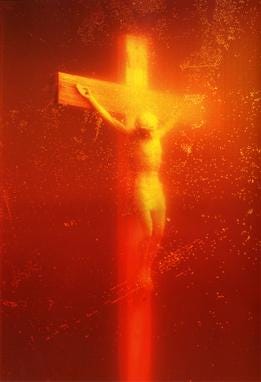
What do you feel when you see this piece of art?
Maybe it was obvious, but this was kind of a trick. That image is the art piece Piss Christ, a photograph of a crucifix immersed in the photographer Andres Serrano’s own urine.31I first learned about this work of art in Carl Trueman, The Rise and Triumph of the Modern Self: Cultural Amnesia, Expressive Individualism, and the Road to Sexual Revolution (Wheaton, IL: Crossway, 2020), and I remember being curious because I shared a first name with the artist. Image source here. But it might help illustrate the dilemma about art. What if someone were genuinely moved when they first encountered this photograph? What if, seeing Jesus with nails through his hands and the appearance of blood, they broke down and gave their life to Christ? Then does it matter how it was composed? Is it wrong that, without context, they found beautiful what many find blasphemous? (To be fair, Serrano defends his work as genuine religious artwork, as he is a lifelong Catholic.)
.jpg)
I’m just asking a lot of questions here. There are lots of people with really strong opinions on these questions online. But if the problem people have with AI art is primarily about quality, it’s going to be a losing battle. Complaints about AI slop online will only land if it remains bad, but if the technology keeps advancing, it’s only a matter of time before it surpasses the quality of human artwork. The most recent versions of image generation are much better than what Midjourney produced in 2022. AI has already won art competitions and beat out humans. So going forward the critics of AI art will have to strike at something deeper, a more fundamental truth about what art is. Where does the value of art come from? Is there objectively good art, or do objective values depend on some subjective criteria that have to do with the thoughts and intentions of human authors?
I’ll leave these questions to be debated by others. Suffice it to say, I would simply say that the AI-generated art in TAOMDE added something to the reading experience. At times it felt like it enhanced my feelings of disgust and disturbance at the content of the dystopian parts of the essay, other times I mostly ignored it. Here are some more samples of the AI art in TAOMDE, so maybe you can be the judge.
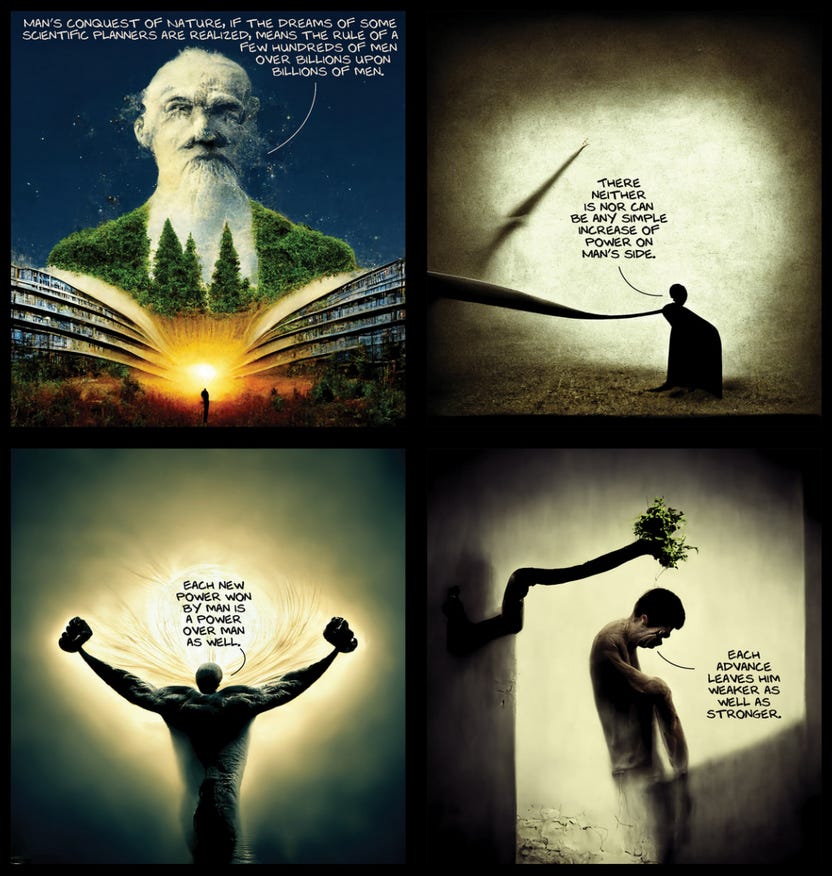
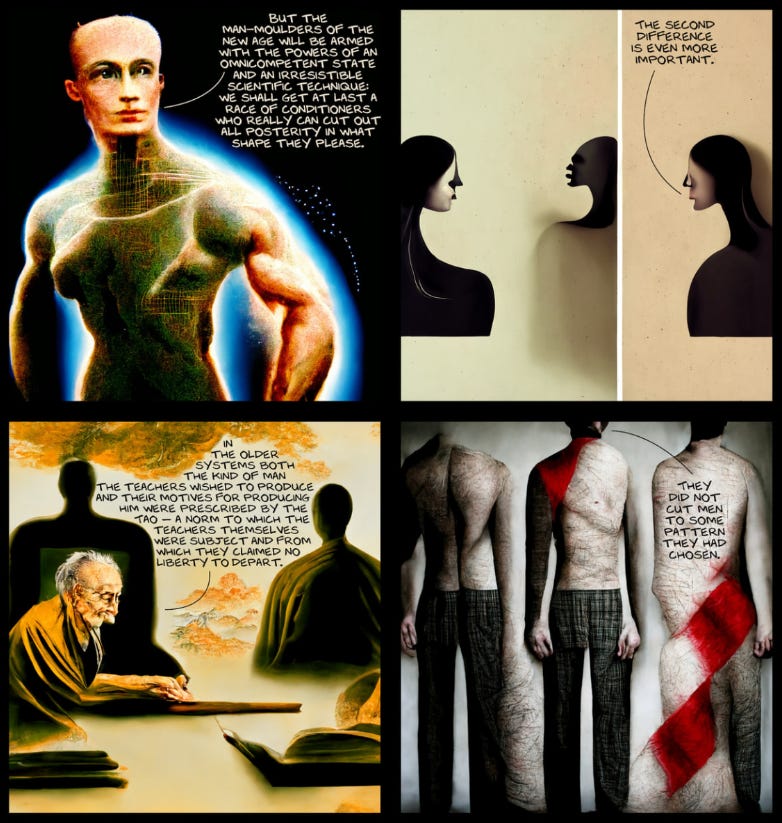
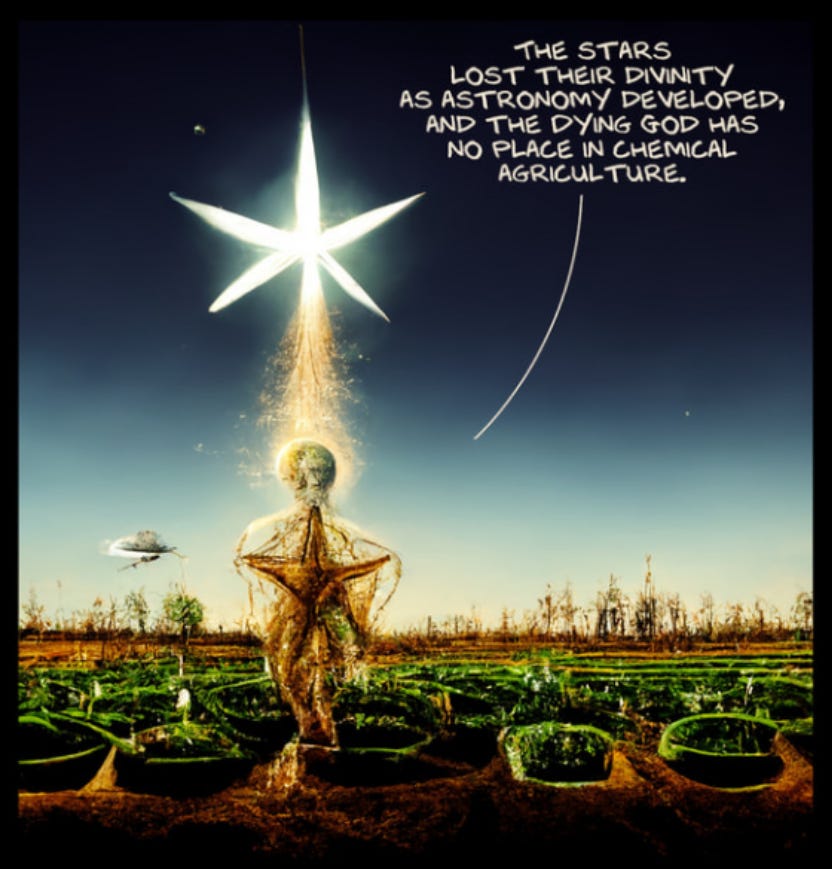
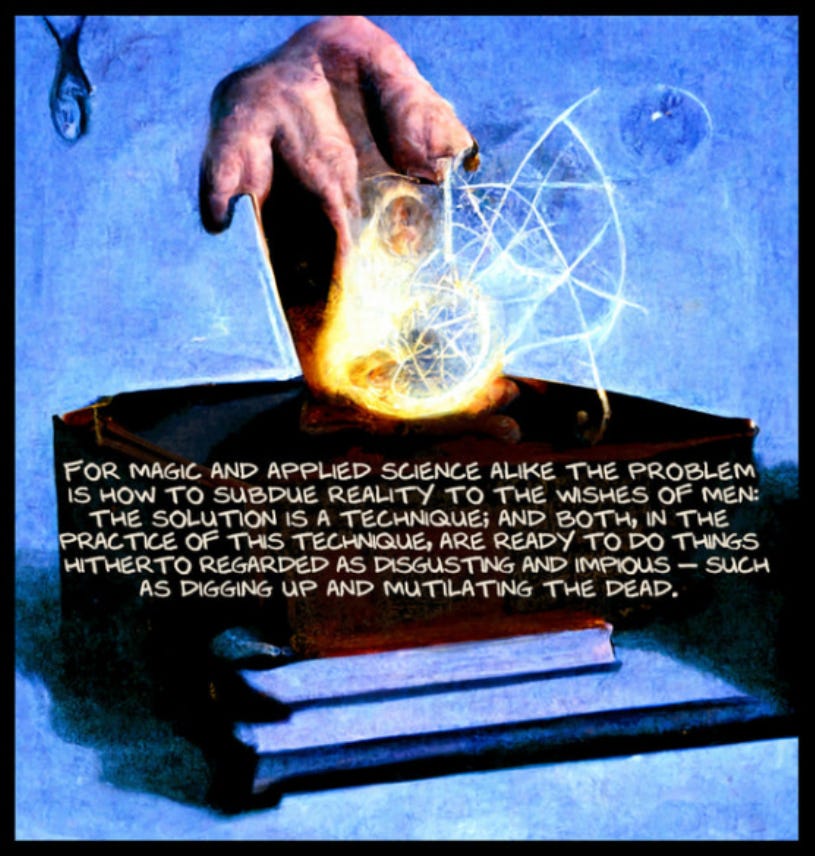
Pretty uncanny. While I don’t immediately get a sense of disgust at AI art that many critics seem to, I do fear a future where we have AI slop everywhere, and no one can tell the difference anymore between AI and real content. (Wait, isn’t that basically what Facebook has become?)
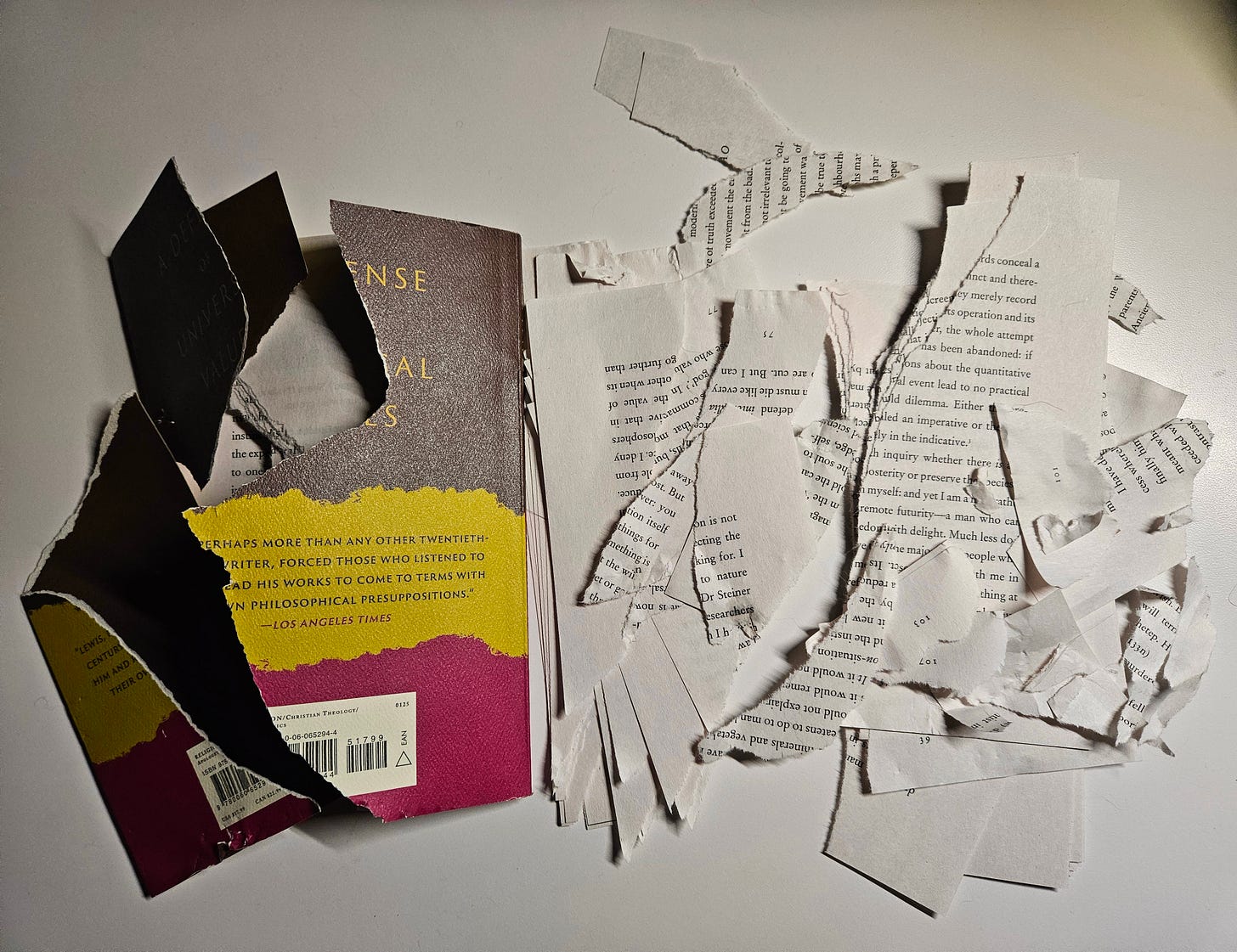
After finishing TAOMDE, I decided to read Lewis’s whole The Abolition of Man. I bought a physical copy, which was promptly destroyed (before I could read a word) by Stella, my German Shepherd. Below is a picture of the destruction. (I feel like there’s something clever I could say here, but I’ve got nothing).
I also wanted a Kindle edition. The HarperCollins edition was almost $10, so I wanted to save some money. First I tried buying a 99 cent Kindle edition, but then I realized that it had a bunch of typos. I found another 99 cent version and bought that, but it was even worse. It made me think, whose fault is it that there are a bunch of bootleg copies of C.S. Lewis’s beloved work on the Kindle store? Come to think of it, it’s not even clear to me the legality of the work I’m reviewing. Is TAOMDE even legal? The Abolition of Man was published in 1943, so according to U.S. copyright law, it would not enter the public domain until 95 years after its publication date, so on January 1, 2039.32The UK has a life+70 rule, so over there it wouldn’t enter the public domain until 70 years after the year of Lewis’s death, meaning it would enter on January 1, 2034. The C.S. Lewis estate (administered by The C.S. Lewis Company Ltd.) retains the copyright until that time. Is feeding every sentence of a work into an AI and then publishing it as a standalone comic “fair use” or “parody”? The copyright page says “The Abolition of Man Deluxe Edition is not endorsed by or associated with the estate of C.S. Lewis, the copyright holders of Lewis’ lectures and essays. Any and all copyright and adaptation rights to Lewis’ works are reserved by the estate of C.S. Lewis.” TAOMDE’s publisher is Living The Line, which is U.S.-based, and TAOMDE was released on September 5, 2023. The most relevant case, Andy Warhol Foundation for the Visual Arts, Inc. v. Goldsmith was decided by the Supreme Court in May 2023, which considered the doctrine of “transformative use,” a component of “fair use.” Fair use considers four factors: “(1) the purpose and character of the use, including whether such use is of a commercial nature or is for nonprofit educational purposes; (2) the nature of the copyrighted work; (3) the amount and substantiality of the portion used in relation to the copyrighted work as a whole; and (4) the effect of the use upon the potential market for or value of the copyrighted work.”33Andy Warhol Foundation for the Visual Arts, Inc. v. Goldsmith, 598 U.S. 508, 4 (2023). Opinion accessed August 25, 2025. In the end, the court held in Warhol v. Goldsmith that those conditions were not met, and that minor alterations don’t make a use transformative when the derivative work is commercial and serves essentially the same purpose as the original. Because Grubaugh uses the full text of the essay, this would be judged with even more scrutiny. Even if the meaning of the work was completely different, transformative use would require TAOMDE to serve a different purpose or market than the original. The Lewis estate could say “illustrated editions of Lewis’s work are a potential licensing market for us,” and therefore claim that TAOMDE infringes on their copyright.34But IANAL so IDRK TBH. So…
Anyway, back to The Abolition of Man. The book has basically become part of the twentieth-century canon, and many people have written on it, so my point here won’t be to review the content. But I will just note some of my own thoughts I had when reading and how they connect to current things I see today.
Lewis presents an illustration of what he calls the Tao (which is elaborated in the appendix) by citing various moral codes from around the world, and shows common patterns between them. Those commonalities—those objective morals—are the Tao. Another name for the Tao might be “Traditional Morality.” Lewis’s thesis throughout the whole book is that we as a society must uphold the Tao, and that the consequence for not upholding it will ultimately be the abolition of man.
Either we are rational spirit obliged for ever to obey the absolute values of the Tao, or else we are mere nature to be kneaded and cut into new shapes for the pleasures of masters who must, by hypothesis, have no motive but their own ‘natural’ impulses. Only the Tao provides a common human law of action which can over-arch rulers and ruled alike. A dogmatic belief in objective value is necessary to the very idea of a rule which is not tyranny or an obedience which is not slavery.35Lewis, The Abolition of Man, 26–27.
When I first became a Christian I was more in the literalist camp of Christianity. I probably would have had hesitation endorsing the Tao, and actually acknowledging that there is anything of value in all the traditions and religions that Lewis cites. But now, I believe I understand better how it all relates to historic beliefs about natural law. The Tao is based in natural law. Natural law has a strong foundation in Christianity. Relatedly, I want to interrogate and expand on some ideas related to the concept of “natural.”
To start, this is how Lewis tries to explain “nature”:
Nature seems to be the spatial and temporal, as distinct from what is less fully so or not so at all. She seems to be the world of quantity, as against the world of quality; of objects as against consciousness; of the bound, as against the wholly or partially autonomous; of that which knows no values as against that which both has and perceives value; of efficient causes (or, in some modern systems, of no causality at all) as against final causes.36Lewis, The Abolition of Man, 31.
Lewis’s definition of nature is a more mechanical one, as he contrasts it with purposes and values. However, I am more interested in a different sense of nature, in relation to Christianity. Generally, I see a reclaiming of the “natural” by Christians today, and in three areas specifically. First, a recovery of “natural theology.” Second, an acknowledgement by Christians of the “natural good” in the world. Third, an embrace of “natural affection” over a kind of liberal cosmopolitanism.37I feel like there could be more things here. Natural food and MAHA crunchiness, for example. But I don’t really have the energy to wade into any more controversial areas than I already have in this essay. (I won’t claim that this is a fully coherent framework, and I think it could still use some refining.)
First, natural theology.
I think natural law requires an understanding of natural theology—it relies on the usefulness of natural revelation and the validity of natural reason. Natural theology “considers the existence, attributes, and operations of God insofar as they may be known through God’s works of creation and providence by means of natural reason.”38Scott Swain, “On Esteeming Natural Theology” (2023). In the same Credo issue, Samuel Parkison has an article entitled “C.S. Lewis’s Argument from Reason.” There seems to have been a retrieval of natural theology within evangelicalism—I can’t really tell when or for how long it’s been happening, maybe since the Young, Restless, Reformed movement. It seems like more and more I see people rejecting dispensationalism as a product of “boomer theology”—the biblicist literal interpretation, which also happens to deviate from most of history’s interpretations. And it seems like for the last few years, Credo Magazine and its Center for Classical Theology were major players in this, trying to recover the stream of theology that begins with the patristics and through the medieval scholastics and reformers, while rejecting modern theology. And part of that classical theology is natural theology.
In July 2025, Matthew Barrett, a well-known Reformed Baptist and founder of Credo, converted to Anglicanism. I am a Reformed Baptist who appreciated Matthew Barrett’s attempt at theological retrieval within the Southern Baptist Convention. I really liked his focus on classical theism, the trinity, and bringing in “the Great Tradition” into the SBC, but he felt like he hit a wall. I think it is a bit dramatic for him to say that because the SBC did not want to tack on the full text of a historic creed to the end of their own creed, that the “Nicene Creed has been officially rejected from inclusion and remains blatantly absent.”39Matthew Barrett, “I am leaving the SBC and becoming Anglican” (2025). Regardless, I don’t think it’s that controversial to say that connections to history and tradition are sorely lacking in modern American evangelicalism. John Henry Newman has a famous quote that “To be deep in history is to cease to be Protestant.”40John Henry Newman, “An Essay on the Development of Christian Doctrine,” found through this essay. But obviously this is not always the case—Protestants (even Baptists) can also appreciate their history. Even in my circles, I’ve personally seen people my age hunger for a rootedness, a connection to an ancient past, a real tradition. We could definitely use more liturgy, and the Church of England’s Book of Common Prayer happens to be one of the best liturgies that the Western world has. Barrett fell in love with it too. My impression of Anglicanism is that there is a range of liberal to conservative Anglican denominations and churches, but because of this has a high potential to serve as a neutral middle-way or mediating center for Christianity going forward.41The Thirty-Nine Articles are fairly conservative and orthodox, but not as binding in a confessional sense from what I can tell. In practice enforcement varies by communion and province. C.S. Lewis was an Anglican. Lewis, it seems, is also one of the most universally loved Christian thinkers, as he can be quoted by almost everyone, liberal or conservative. So, Anglicanism has a strong heritage and I believe a promising future. I for one will remain a Baptist though.
Second, natural good.
C.S. Lewis called the present earthly life we live the “shadowlands.” Just because we live in an imperfect, sometimes dark, world, doesn’t mean there isn’t goodness in it. The world is corrupted by the fall, but neither we nor the rest of creation is utterly depraved. God still gives us grace to do some good and to enjoy the things of earth. He also shows kindness and restraint to all people, believer or nonbeliever, and gives good things to all—this is common grace. Joe Rigney’s book The Things of Earth, is a defense of the “good” things we as Christians can enjoy on earth, without feeling guilt. Not everything needs to be “gospel-centered” to be appreciated as “good.” The natural world is amazing because it is created by God. And if you are a Christian, you can rest knowing that, and not worry about constantly giving thanks to God for the gifts he gives us in the world. You can genuinely enjoy the good things in this world, like baseball and lemonade and the outdoors. And you can enjoy those gifts as gifts, without feeling guilty about enjoying them more than your enjoyment of God; as Rigney says, “to be truly godward is to be manward in the moment.”42Joe Rigney, The Things of Earth: Treasuring God by Enjoying His Gifts (Moscow, ID: Canon Press, 2024), 137. Rigney quotes Lewis often, so here is the relevant Lewis quote: “There is no good trying to be more spiritual than God. God never meant man to be a purely spiritual creature. That is why He uses material things like bread and wine to put the new life into us.”43C.S. Lewis, Mere Christianity (New York, NY: HarperCollins, 2009), 64.
Rigney is now a pastor at Christ Church in Moscow, Idaho, along with Doug Wilson. They are postmillennialists, meaning they believe that we are in the millennium now and that the church will Christianize the world before Christ’s second coming. Postmillennialism isn’t necessary for Rigney’s book, but it does strengthen his thesis, since on his view this world will be around for a long time, and won’t worsen but actually improve. Those gentlemen in Moscow are interesting to me.44I’m not going to list out all the problems with their methods, sometimes called the “Moscow Mood.” If you’re interested, there’s plenty of criticism out there. Where they have seen evangelicalism rejecting the world (or trying too hard to curry favor with it), those in Moscow have looked for ways to utilize the things of this world to advance Christendom. We should do everything in our power to Christianize our community and the nation, and the government should promote Christianity as a religion (they think more positively of “cultural Christianity” than mainstream evangelicals). They want to build up Christian institutions like the Association of Classical Christian Schools and New Saint Andrews College that uphold Christian values and promote objective truth, goodness, and beauty. Personally I think there is value in shifting from the mainstream evangelical “Christ Against Culture” position to a “Christ Transforming Culture” position, as it gives Christians more freedom to engage with the world. (Where I get off the train is the embrace of profanity, cigars, and whiskey. I think those are sufficiently harmful—to individuals and society—that Christians would be wise to avoid them entirely.) Wilson preaches practical pastoral advice instead of only gospel goop; he emphasizes in his videos and blogs that men can’t just look to Christ and trust God to bless them if they are holy and spiritual. Wilson encourages young men to actually better themselves à la Jordan Peterson, be a man, embrace masculinity, and get the girl. Singleness isn’t a “gift” like “Big Eva” says—that’s just a cope—and in marriage, “servant leadership” is a scam—patriarchy is the biblical model. Strong households with strict hierarchies are how the Christian church conquers the world.
Third, natural affection.
Many have pointed out the “meaning crisis” we find ourselves in. I think there is a strong argument that others have made that this has to do with the craziness of the modern world, secularism and disenchantment, and most of all the loss of community in society. This could be summarized by the term disintegration, or disembedding. The reaction to this among some conservatives has been to challenge the postwar consensus on classically liberal capitalist democracies and the “open society” in general. Liberalism results in multiculturalism, pluralism, and secularism. We need to reject this and re-Christianize society. One strand of this view is contained in what Jon Harris describes as the New Christian Right, which essentially adopts Christian Nationalism (as defined by Moscow-aligned Stephen Wolfe). One fundamental idea is that Christians should still appreciate our “natural affection” (or storge)—love for our “family, tribe, and nation.”45“Statement on Natural Affection.” This is related to the recent political debates about foreign aid and the ordo amoris, and what one country’s duties are to another.46You can find a summary of J.D. Vance’s comments from earlier this year here and some commentary here. The New Christian Right would question the idea that you can have a “propositional nation”—nations are made of people, not ideas. And it’s not wrong to prioritize care for those in your nation. (A parallel movement I align more with is postliberalism. Postliberals call for a return to a more grounded, community-oriented society—“guild, ward, and congregation”—and the “strong gods” that bring people together. Government’s priority should be the common good, which includes within it virtue, not just hedonism. On many issues they would be more in line with Catholic social teaching.47For more on postliberalism, check out Patrick Deneen, Why Liberalism Failed (New Haven, CT: Yale University Press, 2018) and Patrick Deneen, Regime Change: Toward a Postliberal Future (New York, NY: Sentinel, 2023). )
One concerning direction of the focus on natural affection is the allure of race realism, ethno-nationalism, and ultimately racism. This can result from accepting the premise that it is okay to want to live among just your own people, with whom you share “blood and soil,” and quickly turns into racism. A while back Corey Mahler had debates with Samuel Sey and James White on the topics of racial differences. Mahler’s view hinges a lot on natural theology and the idea that we can learn a lot from natural things like genetics and crime statistics. But Mahler’s view is really quite dark, and the sinister conclusion of prioritizing natural affection over love for fellow believers. If you say someone of your own race shares more in common with you than a brother in Christ, something is wrong. James White put it well in his closing statement of the debate:
When someone says “my people”… My people are the people who bow the knee to Jesus Christ. My people are the people in Revelation chapter 5 from every tongue, tribe, people, and nation that have been made one people by the sacrificial work of the Lamb of God, and we have been made a kingdom and priest unto his father. Those are my people. And once you lose that, you no longer have the church of Jesus Christ; you have an ethnic, racial club.48Bibledingers, “James White Vs. Corey Mahler Debate Black Sanctification.”
So, those are just some of my random reflections on the Tao and its relation to the state of one niche corner of conservative Christendom—a retrieval of natural theology, natural good, and natural affection. Like I said, just experimental.
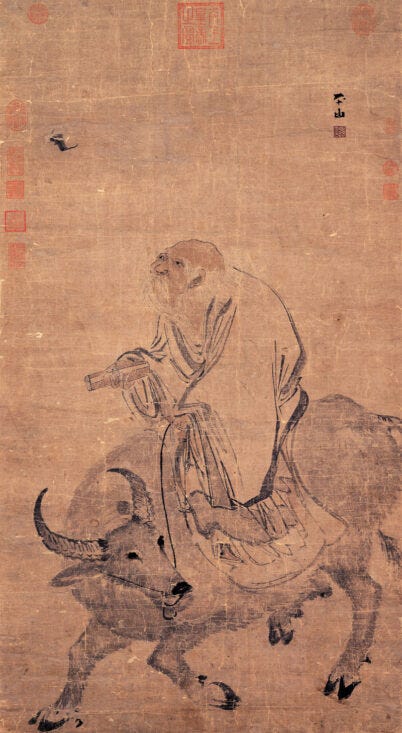
One thought I had while reading The Abolition of Man was how prescient it felt. It seems especially well-suited to our moment right now—not only because of the meaning crisis, but even more so as we witness the rise of what might be the most transformative technologies humans will ever create. I find it hard to read this passage and not think about the current moment of rapid technological progress:
Each generation exercises power over its successors: and each, in so far as it modifies the environment bequeathed to it and rebels against tradition, resists and limits the power of its predecessors. This modifies the picture which is sometimes painted of a progressive emancipation from tradition and a progressive control of natural processes resulting in a continual increase of human power. In reality, of course, if any one age really attains, by eugenics and scientific education, the power to make its descendants what it pleases, all men who live after it are the patients of that power. They are weaker, not stronger: for though we may have put wonderful machines in their hands we have preordained how they are to use them. And if, as is almost certain, the age which had thus attained maximum power over posterity were also the age most emancipated from tradition, it would be engaged in reducing the power of its predecessors almost as drastically as that of its successors. And we must also remember that, quite apart from this, the later a generation comes—the nearer it lives to that date at which the species becomes extinct—the less power it will have in the forward direction, because its subjects will be so few. There is therefore no question of a power vested in the race as a whole steadily growing as long as the race survives. The last men, far from being the heirs of power, will be of all men most subject to the dead hand of the great planners and conditioners and will themselves exercise least power upon the future.
The real picture is that of one dominant age—let us suppose the hundredth century AD—which resists all previous ages most successfully and dominates all subsequent ages most irresistibly, and thus is the real master of the human species. But then within this master generation (itself an infinitesimal minority of the species) the power will be exercised by a minority smaller still. Man’s conquest of nature, if the dreams of some scientific planners are realized, means the rule of a few hundreds of men over billions upon billions of men. There neither is nor can be any simple increase of power on Man’s side. Each new power won by man is a power over man as well. Each advance leaves him weaker as well as stronger.49Lewis, The Abolition of Man, 34.
This is a terrifying picture. I think there is a very good chance we are this most dominant generation—and we got here much earlier than the hundredth century. Lewis talks about what it would take to get to that stage:
[The] manmoulders of the new age will be armed with the powers of an omnicompetent state and an irresistible scientific technique: we shall get at last a race of conditioners who really can cut out all posterity in what shape they please.50Lewis, The Abolition of Man, 27.
I heard someone say once that the successive Industrial Revolutions have increasingly made us more “like God”: the First gave us power through machines, the Second gave us reach through communication and transportation, and the ongoing Third and Fourth have given us mastery over information—we have become omnipotent, omnipresent, and omniscient (but not truly).51I heard this from my pastor years ago; I’m not sure if he came up with the concept himself. But a version of it is contained in this podcast he hosted. Yet there is still one future technology in particular that its creators insist will make us truly “omnicompetent”—Artificial General Intelligence (AGI). AGI will elevate us to the omnicompetent dominant generation. AGI could cause an intelligence explosion, and that could further every other area of science. Some people refer to this scenario as a technological singularity. There are new technologies on the horizon which could give us unprecedented control over nature and permanently transform humanity as a species—biotech, nanotechnology, robotics—and once they are released into the world, they’ll be really hard to reel back in.
I think The Abolition of Man should be read by everyone who might fall under the label of TESCREAL (which stands for Transhumanism, Extropianism, Singularitarianism, Cosmism, Rationalism, Effective Altruism [EA], and Longtermism52I know this term isn’t great and represents a wide bundle; for more discussion on the term see this article. I am mostly sympathetic to EA, but not the others on the list. ), and especially anyone that considers themselves e/acc-style accelerationists (not that they would waste their time on a book). There are some EA-aligned people I know of who have reflected on this passage by Lewis.53For a further exploration of Lewis and EA, see this article by Mike Morell. Toby Ord in his book The Precipice talks about the “single generation” that could harness technology to the point that they effectively control and subjugate all future generations by their choices, inadvertently resulting in what he calls “desired dystopia.”54Toby Ord, The Precipice: Existential Risk and the Future of Humanity (New York, NY: Hachette, 2020), 156, 375. Joe Carlsmith of Open Philanthropy has an essay where he relates Lewis’s essay to the concept of longtermism and avoiding what Will MacAskill has called “value lock-in.”55This is further discussed in William MacAskill, What We Owe The Future (New York, NY: Hachette, 2022). See also Scott Alexander’s famous post “Meditations on Moloch” on coordination problems. EA legend Holden Karnofsky, who now works at leading AI lab Anthropic, has called ours “the most important century.” What all these people are trying to say is, whatever we choose to do in the next few years could reverberate throughout the rest of human history, and potentially be the difference between humanity’s future being one full of suffering and one full of flourishing. How well it goes depends on what we do now, at this hinge of history. With AI here, we are the master generation that Lewis foresaw, and we should wake up and take that role seriously. Whether one has a fast or slow timeline on the transformativeness of AI, there’s no denying that it will be transformative. In one widely circulated report, AI 2027, forecasters predicted what the next few years and then beyond might look like. They lay out two possible futures: one where we slow down the AI race and another where it speeds up. Either scenario though sees the next decade as radically transformed—either we’re all dead, or we’ve become a star-faring civilization. This would mean that our actions in the next few years are critical.
Given AI’s potential to make us that master generation, what should our view toward AI be now? I want to first explore three different ways in which today’s AI discourse understands the “abolition of man”—what I call the Jezosian–transhumanist–accelerationist view, the Yudkowskian–safetyist–doomer view, and the Kingsnorthian–technophobic–spiritual view.56Yudkowsky and Kingsnorth both have books coming out later this month, If Anyone Builds It, Everyone Dies and Against the Machine, respectively. I think they will complement each other well; I plan on reading them! First, there is the Beff Jezos (yes, Beff Jezos—not Jeff Bezos) view that humanity as a species can eventually be forgotten as civilization climbs the Kardashev scale and breaks free of its limitations. Jezos is an e/acc, whose movement manifesto states: “if one seeks to increase the amount of intelligence in the universe, staying perpetually anchored to the human form as our prior is counter-productive and overly restrictive/suboptimal.”57Beff Jezos and bayeslord, “Notes on e/acc principles and tenets” (2022). On this view, there’s nothing really that special about humanity specifically, and our real role in the universe might just be to usher in a new and better form of intelligence. In this case, the abolition of man is a positive thing—a sign of success for the universe and the laws of physics. I’ve touched on related ideas in a previous essay arguing against AI sentience—from a Christian perspective this view should be off the table.58Peter Thiel, an extremely influential entrepreneur and self-described Christian, exhibited this view on a now-infamous podcast with Ross Douthat when he was questioned about whether the human race should endure; he didn’t really have an answer, but Douthat picked up that his hesitation revealed a lot. Second, there is the Eliezer Yudkowsky view that superintelligent AI will literally kill everyone. This is the view of many technologists who see superintelligence truly as an existential threat—there is no known way to develop friendly AI and therefore we are racing towards our own destruction as AI labs underestimate the power of what they are building. Yudkowsky has discussed being prepared to destroy rogue data centers by airstrike. This view advocates doing everything in our power to prevent the literal abolition of man, and pausing the development of AI seems to be the most important thing right now to that end. Third, there is the Paul Kingsnorth view that AI will lead to the spiritual death of man by means of dehumanization. Our souls, what makes us human, will be crushed by the techno–industrial complex which he calls the Machine. Kingsnorth has more of a neo-Luddite approach. Whereas Yudkowsky is narrowly concerned about AI, Kingsnorth takes issue with a broader set of issues that reinforce the Machine, like rampant capitalism, secularism, and modernity as a whole. Ultimately our woes stem from a spiritual crisis, and the technology we can hardly harness only exacerbates it. His solution is spiritual renewal—part of which will involve the ancient spiritual discipline of asceticism, specifically a kind of “technological askesis,” choosing to abstain from the march of the Machine. I believe Kingsnorth’s view would be the most aligned with Lewis.59It’s important to note that Lewis did stress that he was not anti-science. He was merely against science being done by a small group of people that have abandoned the Tao. Fully accepting the irony, I asked ChatGPT to guess what Lewis might say today about the AI situation: “As we train our engines to carry our thinking, we are tempted to lay down the office of the thinking man; and the more we boast of mastering Nature by our contrivances, the more she masters us through appetite and fashion, until at last we find our tools have become our tutors and our servants our rulers, and we wake to the quiet abolition of man.”60From a conversation with ChatGPT, GPT-5 Thinking model on August 24, 2025.
I agree with Yudkowsky about the danger of our lack of understanding of AI, and also with Kingsnorth and Lewis in their fear about how AI will change us.61I appreciate the Yudkowskian–safetyist–doomer camp for working on ways to slow down the rapid progress, or at least ensure the safety of each new development. As interesting as it is to think about alignment and all, it seems like the AI companies have not set aside their end goal of AGI. We should be paying attention. There are major new developments every month, and in my work as a software engineer I am urged to use AI often. People who haven’t used AI yet will soon be seeing it everywhere, and interacting with AI more and more. As time goes on I see fewer realistic options for slowing down the Machine.
How should we then live in such a time as this? Can we prevent the abolition of man? Can the Lewis–Kingsnorthian–technophobic–spiritual approach hold up to the steamrolling progress of the Machine, or will humanity have to actually fight back, rage against the Machine in a Butlerian Jihad, and carpet bomb the data centers? Is there hope? I don’t have it all figured out, but I tried to address this angst a few years ago in an anti-longtermism essay.
[We can] reasonably surrender the future to God and not be anxious about it; believers are promised earthly suffering not in the form of existential threat outcomes, but persecution and tribulation (Matt. 6:25−34, Matt. 24). And we know God has eternally executed his perfect plan for humanity and the world, fully aware of anything that would appear to genuinely threaten the human race. What we call existential risks to God may simply be never-actualized possibilities, or the means by which he brings about the eschaton … Even assured that God would likely not allow the dangers we face to actually become legitimate extinction events, humans still have responsibility … Importantly, the burden of bringing about utopia is not laid on humans.62My Substack post, “Christianity and Longtermism” (2022).
Maybe more simply, “Be still and know that I am God.”63Psalm 46:10.
My point is: we can genuinely trust God. I know very well how that can be a platitude that dismisses the severity of actual issues, but genuine trust in God will help. If it starts looking grim out there, we can remember Gamaliel’s principle: “if this counsel or this work be of men, it will come to nought … if it be of God, ye cannot overthrow it.”64Acts 5:38–39. Also see a short article on the principle here. Our technology can never get in the way of God’s plans, and God will not allow the absolute abolition of man. Though on the other hand, our responsibility in the world is real too. It can be difficult to look around and feel dismayed about the inaction of others, but thankfully we can still act ourselves. This action can range from quiet personal resistance to advocating for policy change. (There are concrete ways to have an impact in this area.65For actual advice on how best to use your talents, you can talk with people at Christians For Impact or 80,000 Hours. If you’re concerned about AI, and really want to do something about it, there are opportunities to do so. ) Trusting God and taking action are not contradictory but complementary: we act with confidence because we trust God. And we can trust our God-given minds that as long as we use discernment, we don’t have to second-guess what we choose to do, even considering the huge stakes mentioned earlier. God will work all things out for his good. Instead of immanentizing the eschaton, we can recommit to living out God’s calling in our lives daily.
It can help to remember that our current moment is not necessarily as unique as it might seem. There was another time in history where humanity also had to grapple with the specter of the abolition of man. The Trinity test in 1945 ushered in a new era of human history, the Atomic Age, where for the first time humanity became capable of legitimately annihilating itself. In 1948, three years after the first nuclear weapons had been used and their destructive potential proven, C.S. Lewis wrote an essay titled “On Living in an Atomic Age,” in which he gave counsel as to how to live when the threat of civilization-destroying weapons loomed large:
[You] and all whom you love were already sentenced to death before the atomic bomb was invented: and quite a high percentage of us were going to die in unpleasant ways ... It is perfectly ridiculous to go about whimpering and drawing long faces because the scientists have added one more chance of painful and premature death to a world which already bristled with such chances and in which death itself was not a chance at all, but a certainty … If we are all going to be destroyed by an atomic bomb, let that bomb when it comes find us doing sensible and human things—praying, working, teaching, reading, listening to music, bathing the children, playing tennis, chatting to our friends over a pint and a game of darts—not huddled together like frightened sheep and thinking about bombs.66C.S. Lewis, “On Living in an Atomic Age.”
I find this quote very encouraging, even if I don’t think God would allow humanity to be wiped out. Our current AI moment, where American and Chinese companies are competing and several are on a mission to develop AGI, has drawn frequent comparison to the nuclear arms race. There’s a lot of anxiety; we may be close to living in an AGI Age. Ultimately no one knows what will pan out in the next decade, but no matter what you think might happen, it’ll help to heed Lewis’s wise words from an earlier era.
I appreciate Grubaugh’s afterword to the last issue of TAOMDE, as a final charge, in the face of the coming storm.
We can worry about, or celebrate, the future of humanity in the face of AI all we like but it is up to you to tune in, to turn on, to consume, to create, to love, to turn off, to stop and smell a real rose, ultimately to live your life as you see fit.
What will you do with that life?
Will it be one of submission to external forces? Complacent consumption of mere content? Will you happily be a produmer (to use another of Luciano’s neologisms) who produces more information by consuming than through any other means of creativity?
Or, will you be the one who carefully, thoughtfully, unselfishly, looks at the Infosphere around you and chooses, like a real adult, to take up the responsibilities of caring?
In a world where there is nothing new under the Sun, choose to change the Sun.67Grubaugh, TAOMDE, afterword to Issue #5.
Read apart from the Tao, this could collapse into individualism. But anchored in the natural law of the Tao, we can recognize the real calling here of faithful stewardship and walking in the good works prepared for us.
Final rating
6/10. Makes you think.
Footnotes
- 1.
Some might say that long tangents are a sign of bad writing, but that’s my favorite part of those reviews. So apologies if you’re not used to it. If you just want my review of the main comic, you could technically skip parts 6 through 2. For just my philosophizing on AI, you can skip to after the image of Lao Tzu (or this link).
- 2.
No relation to this other book review of the book written by the guy that read every single Marvel comic book ever published. Sounds like an interesting book though.
- 3.
Edward Nevraumont, “Your Book Review: Silver Age Marvel Comics” (2024).
- 4.
Substack estimates this post takes an hour to read.
- 5.
I like to poke fun of my dad for this—one of my favorite The Onion skits to share with my family is “How Will The End Of Print Journalism Affect Old Loons Who Hoard Newspapers?”
- 6.
Because of my dad I’m also a recovering news junkie (or, ex-infovore). Now I feel that longform content on Substack or in magazines is better than traditional news.
- 7.
Some other favorites: Mutts, Get Fuzzy, The Far Side, Zits, Garfield (but only the old Garfield). And it’d be criminal to not mention the entire Calvin and Hobbes collection.
- 8.
“Experimental” in my title has two meanings—the graphic novel itself is experimental, and this book review is also experimental (for me).
- 9.
This one from The Comics Journal is good.
- 10.
Carson Grubaugh, TAOMDE / The Abolition of Man: Deluxe Edition (St. Paul, Minnesota: Living the Line, 2023), back cover.
- 11.
I only have one physical individual issue of the series, the first one. I thought maybe it would increase in value, but so far it hasn’t really.
- 12.
Six is the number of man.
- 13.
Carson Grubaugh, “Information” (2007).
- 14.
Hans Madueme, Defending Sin: A Response to the Challenges of Evolution and the Natural Sciences (Grand Rapids, MI: Baker Academic, 2024), 16.
- 15.
Carson Grubaugh, “The Ethical Obligations of a Banal, Content Apocalypse” (2016).
- 16.
From the archived page here: https://web.archive.org/web/20230123002405/https://www.patreon.com/livingtheline.
- 17.
In 2020, Batman: Death in the Family was made into an “interactive” animated movie. I never played it. In that movie/game, the viewer can make choices (I assume through a similar mechanism to the old DVD menus or something) that influence the story. For example, if Robin dies, then the events of the 2010 movie Batman: Under the Red Hood play out.
- 18.
One organization working to combat link rot is the Internet Archive. I was able to find the Patreon through the Internet Archive’s tool called the Wayback Machine, which archives webpages, so that even if a link no longer works, someone can paste the link into the Wayback Machine and see what the page looked like on a certain date.
- 19.
W3C, “What is Hypertext?”
- 20.
Quote from the project’s mission statement according to the Project Xanadu Wikipedia page, accessed August 25, 2025. (Although from a Google search this quote might be a case of citogenesis.)
- 21.
Luciano Floridi, “On Human Dignity as a Foundation for the Right to Privacy” (2016).
- 22.
Floridi, “On Human Dignity.”
- 23.
Floridi, “On Human Dignity.”
- 24.
Carson Grubaugh, HodTech, Part One (2022).
- 25.
Grubaugh, HodTech.
- 26.
The text of the “The Abolition of Man” lecture is actually not that long, only about 5,600 words. This book review alone is more than double that length.
- 27.
Midjourney is accessed through the social media app Discord. I’ve used it before and it’s good, but this makes it somewhat difficult to use. Usually it spits out four distinct images per prompt for you to choose from, which is what Grubaugh did.
- 28.
C.S. Lewis, The Abolition of Man (New York, NY: HarperCollins, 2009), 36.
- 29.
Scott McCloud, Understanding Comics: The Invisible Art (New York: HarperPerennial, 1994), 153–161.
- 30.
An example edge case of this might be some piece “modern art” that is just a blank white canvas that the artist claims has lots of meaning. I’d like to be able to say that it is objectively bad or meaningless, but then what is my objective standard?
- 31.
I first learned about this work of art in Carl Trueman, The Rise and Triumph of the Modern Self: Cultural Amnesia, Expressive Individualism, and the Road to Sexual Revolution (Wheaton, IL: Crossway, 2020), and I remember being curious because I shared a first name with the artist. Image source here.
- 32.
The UK has a life+70 rule, so over there it wouldn’t enter the public domain until 70 years after the year of Lewis’s death, meaning it would enter on January 1, 2034.
- 33.
Andy Warhol Foundation for the Visual Arts, Inc. v. Goldsmith, 598 U.S. 508, 4 (2023). Opinion accessed August 25, 2025.
- 34.
But IANAL so IDRK TBH.
- 35.
Lewis, The Abolition of Man, 26–27.
- 36.
Lewis, The Abolition of Man, 31.
- 37.
I feel like there could be more things here. Natural food and MAHA crunchiness, for example. But I don’t really have the energy to wade into any more controversial areas than I already have in this essay.
- 38.
Scott Swain, “On Esteeming Natural Theology” (2023). In the same Credo issue, Samuel Parkison has an article entitled “C.S. Lewis’s Argument from Reason.”
- 39.
Matthew Barrett, “I am leaving the SBC and becoming Anglican” (2025).
- 40.
John Henry Newman, “An Essay on the Development of Christian Doctrine,” found through this essay.
- 41.
The Thirty-Nine Articles are fairly conservative and orthodox, but not as binding in a confessional sense from what I can tell. In practice enforcement varies by communion and province.
- 42.
Joe Rigney, The Things of Earth: Treasuring God by Enjoying His Gifts (Moscow, ID: Canon Press, 2024), 137.
- 43.
C.S. Lewis, Mere Christianity (New York, NY: HarperCollins, 2009), 64.
- 44.
I’m not going to list out all the problems with their methods, sometimes called the “Moscow Mood.” If you’re interested, there’s plenty of criticism out there.
- 45.
- 46.
- 47.
For more on postliberalism, check out Patrick Deneen, Why Liberalism Failed (New Haven, CT: Yale University Press, 2018) and Patrick Deneen, Regime Change: Toward a Postliberal Future (New York, NY: Sentinel, 2023).
- 48.
Bibledingers, “James White Vs. Corey Mahler Debate Black Sanctification.”
- 49.
Lewis, The Abolition of Man, 34.
- 50.
Lewis, The Abolition of Man, 27.
- 51.
I heard this from my pastor years ago; I’m not sure if he came up with the concept himself. But a version of it is contained in this podcast he hosted.
- 52.
I know this term isn’t great and represents a wide bundle; for more discussion on the term see this article. I am mostly sympathetic to EA, but not the others on the list.
- 53.
For a further exploration of Lewis and EA, see this article by Mike Morell.
- 54.
Toby Ord, The Precipice: Existential Risk and the Future of Humanity (New York, NY: Hachette, 2020), 156, 375.
- 55.
This is further discussed in William MacAskill, What We Owe The Future (New York, NY: Hachette, 2022). See also Scott Alexander’s famous post “Meditations on Moloch” on coordination problems.
- 56.
Yudkowsky and Kingsnorth both have books coming out later this month, If Anyone Builds It, Everyone Dies and Against the Machine, respectively. I think they will complement each other well; I plan on reading them!
- 57.
Beff Jezos and bayeslord, “Notes on e/acc principles and tenets” (2022).
- 58.
Peter Thiel, an extremely influential entrepreneur and self-described Christian, exhibited this view on a now-infamous podcast with Ross Douthat when he was questioned about whether the human race should endure; he didn’t really have an answer, but Douthat picked up that his hesitation revealed a lot.
- 59.
It’s important to note that Lewis did stress that he was not anti-science. He was merely against science being done by a small group of people that have abandoned the Tao.
- 60.
From a conversation with ChatGPT, GPT-5 Thinking model on August 24, 2025.
- 61.
I appreciate the Yudkowskian–safetyist–doomer camp for working on ways to slow down the rapid progress, or at least ensure the safety of each new development. As interesting as it is to think about alignment and all, it seems like the AI companies have not set aside their end goal of AGI.
- 62.
My Substack post, “Christianity and Longtermism” (2022).
- 63.
Psalm 46:10.
- 64.
Acts 5:38–39. Also see a short article on the principle here.
- 65.
For actual advice on how best to use your talents, you can talk with people at Christians For Impact or 80,000 Hours. If you’re concerned about AI, and really want to do something about it, there are opportunities to do so.
- 66.
C.S. Lewis, “On Living in an Atomic Age.”
- 67.
Grubaugh, TAOMDE, afterword to Issue #5.